Nicolas Davalos


Other projects

Restoring Our Reefs (ROR) is the third phase of a long-term coral restoration effort in the Galápagos Islands, building on the scientific and community foundations established through the Galapagos Coral Restoration Initiative and the Galapagos Reef Revival project. The Galápagos once supported some of the most biologically rich coral reefs in the Eastern Tropical Pacific, but more than 95% of reef cover collapsed during the 1982–83 El Niño event. Today, remaining coral colonies are scarce, isolated, and highly vulnerable, yet they hold extraordinary ecological and genetic value for regional reef recovery. ROR seeks to safeguard these remnant populations and restore coral ecosystems through science-based restoration, community engagement, and environmental education.
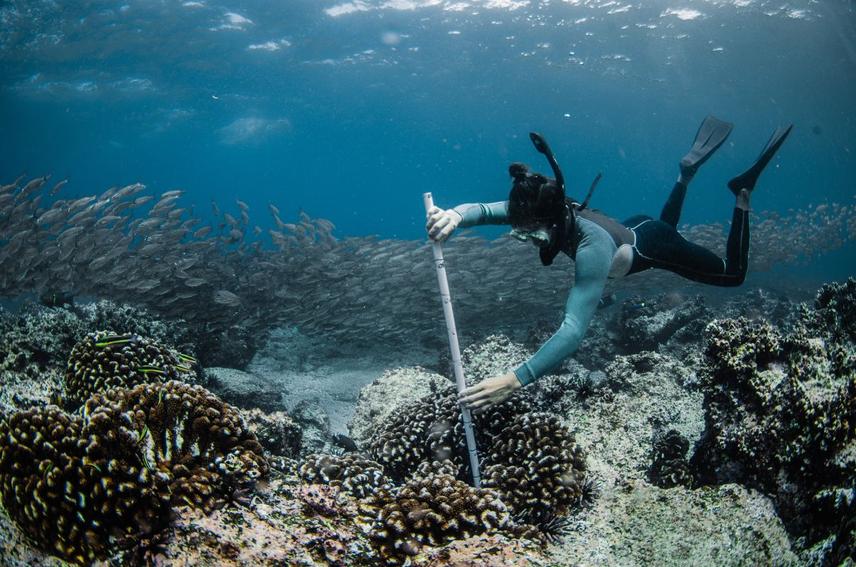
Coral fragments are cultivated in underwater nurseries for 9-12 months, until they reach a large enough size to be transplanted back to the reef © Nicolas Davalos / Galapagos Reef Revival
The project aims to increase coral abundance, diversity, and resilience by expanding nursery capacity, propagating more than 2,000 new coral fragments, and introducing over 60 genetically distinct coral varieties into restoration sites. Using coral gardening techniques—including table-frame, mid-water tree, and rope nurseries—corals will be cultivated, monitored, and outplanted following a Before-After-Control-Impact (BACI) framework to ensure measurable ecological impact. ROR prioritizes locally threatened species such as Pocillopora damicornis, whose remaining Galápagos population is monogenotypic and extremely vulnerable to disturbance.
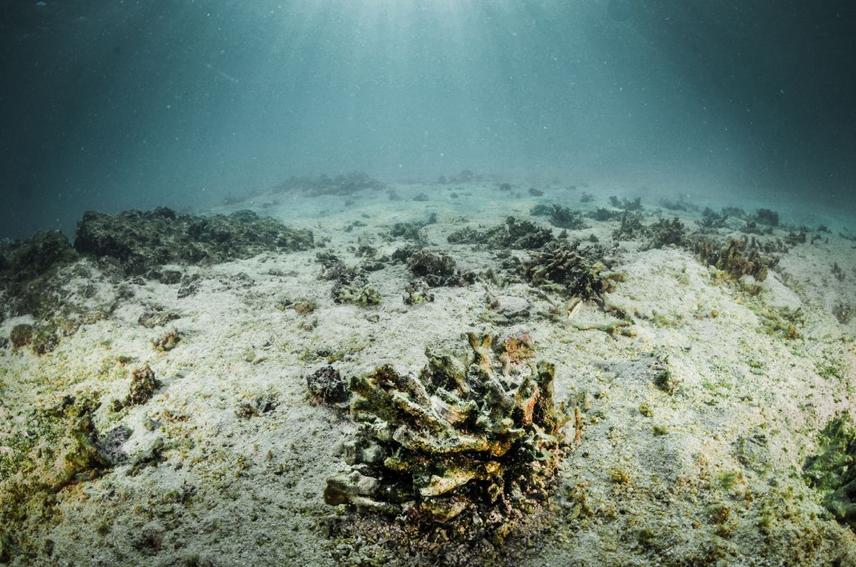
The Galápagos Islands once hosted some of the richest reef assemblages of the Eastern Pacific, before loosing over 95% of its coral cover to coral bleaching, product of the historical El Niño event of 1983 © Nicolas Davalos / Galapagos Reef Revival
Equally central to the project is community stewardship. ROR will actively involve fishers, guides, park rangers, students, and residents through coral restoration workshops, experiential learning, and a citizen science monitoring program. These activities build local capacity, strengthen environmental literacy, and ensure long-term support for reef conservation. Partnerships with schools and tourism operators will embed coral education into curricula, tourism practices, and community culture.
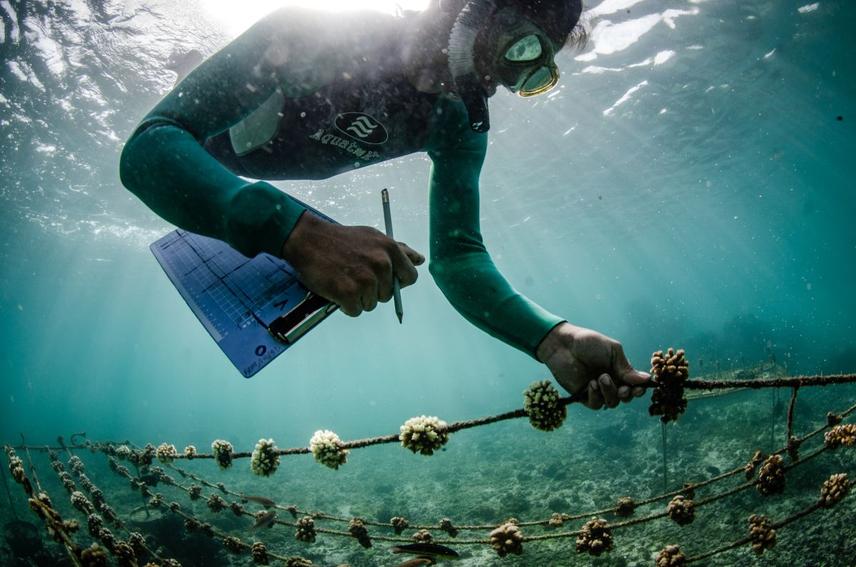
Local field assistants monitor coral health in underwater nurseries, measuring bleaching during seasonal changes in sea surface temperature © Nicolas Davalos / Galapagos Reef Revival
Finally, the project will develop a sustainable model that links conservation with local livelihoods through educational and experiential programs. This approach aims to generate long-term support for restoration while empowering stakeholders with new skills. Together, these efforts work toward a resilient, community-supported model for coral recovery in one of the world’s most iconic marine ecosystems.
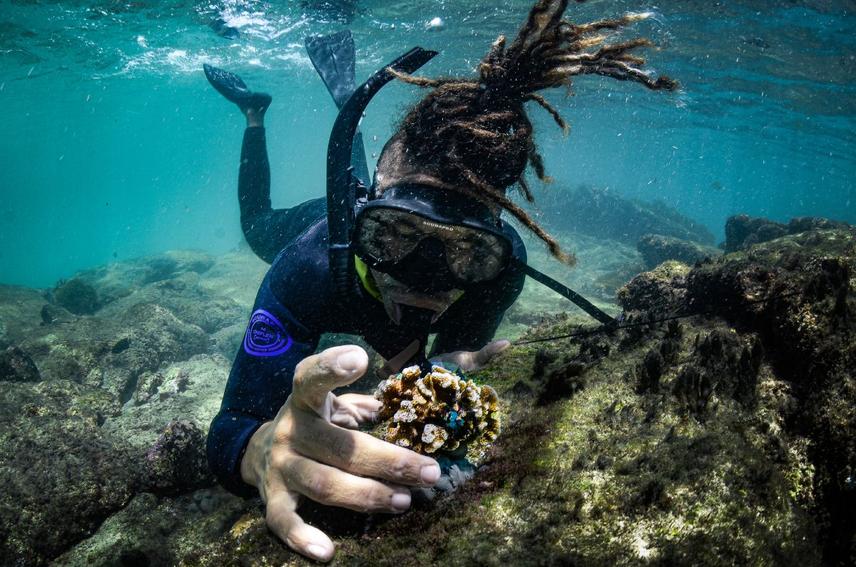
After nearly a year of coral cultivation, the team transplants mature corals back to degraded reef areas © Nicolas Davalos / Galapagos Reef Revival