Habib Delfino Ahumada


The Pink Fairy Armadillo (Chlamyphorus truncatus) is the world’s smallest armadillo and one of the most elusive mammals on Earth. Endemic to the arid and semi-arid regions of central Argentina, its cryptic behaviour and fossorial lifestyle pose unique challenges to its conservation. The stable underground environment shields this species from external threats but also makes it extremely sensitive and vulnerable. This may help explain why it rarely comes outside, making it difficult for science to study and reconstruct its life history. Major threats include habitat degradation, domestic animal predation, and illegal collection. The lack of information is reflected in its conservation status of Data Deficient at both the national (SAREM-SAyDS) and international (IUCN) levels.
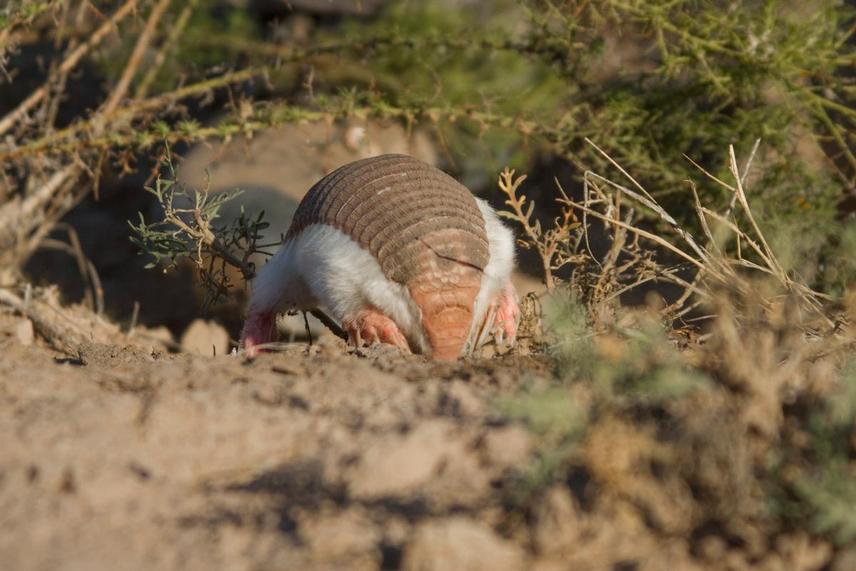
Pink Fairy Armadillo (Chlamyphorus truncatus) in their typical environment. © Esteban Soibelzon (@esoibel)
Over several years of research, we developed an effective approach to studying this species, using citizen science as a powerful tool. This was key to collecting and analysing a large volume of information, where local people living alongside the Pink Fairy Armadillo played a key role in our project, sharing their knowledge and experiences with us and helping us to jointly build fundamental aspects of the biology and ecology of C. truncatus.
Through talks and workshops open to the community and surveys of local residents, combined with outreach through our social networks, the Pink Fairy Armadillo, present in the collective imagination of people due to its strange and peculiar nature, began to tell a story. This wove a social network in the southern part of its range (La Pampa Province), driven by people's curiosity and interest in learning about this species and contributing to our research project. Today, we have more than 15 annual records from the southern part of its distribution, and we have gone from having 7 records at the beginning of our project to more than 150 records for this province. This has helped us to identify the areas of greatest presence, as well as the main threats facing the species.
Our next challenge with the Rufford Foundation project aims to generate essential data for the conservation of C. truncatus in the northern part of its range, in Catamarca Province, through extensive fieldwork, community engagement, and multidisciplinary scientific approaches, allowing us to reconstruct its history throughout its entire range.
We currently have tissue samples from the southern range (obtained from deceased individuals reported by local collaborators) and intend to supplement them with samples from the north, enabling us to conduct a comprehensive population genetics study revealing insights into population connectivity, genetic health, and parasite-host dynamics, so that we can assign it a true conservation category.