Amanda Pereira Leite

This project aims to investigate how populations of the seahorse Hippocampus reidi are distributed within the Rio Tubarão estuary and which environmental factors influence this distribution. The Rio Tubarão is a negative estuary, an environment where salinity exceeds that of the adjacent sea due to limited water renewal, high evaporation, and semi-arid climatic conditions. Such systems impose strong physiological and ecological pressures on resident species and are considered among the most unique and challenging aspects of estuarine ecology. Although negative estuaries represent important ecological features in Northeastern Brazil, they remain poorly studied, particularly regarding long-term population responses to environmental change.
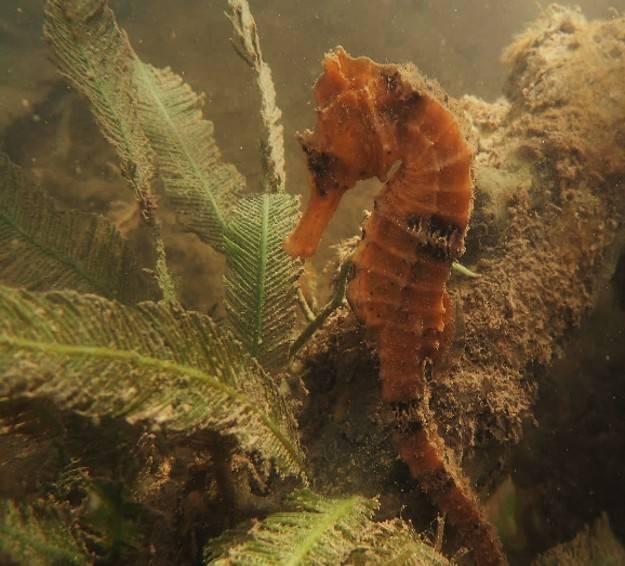
Female Hippocampus reidi specimen in the Tubarão River estuary – RN (2018). © Photo T.P.R. Oliveira. LAPEC-UEPB Collection
More than twenty years ago, scientific studies documented some of the highest known densities of H. reidi along the Brazilian coast, specifically within a negative estuary in the Northeast. As a mangrove-dependent and threatened species, seahorses are highly sensitive to environmental alterations and strongly vulnerable to changes in habitat structure and water conditions. However, after two decades without updated monitoring, there is a critical information gap regarding how these populations are responding to accelerating human pressures, coastal development, and climate-driven environmental change.
This project will address this gap by conducting systematic surveys in the Rio Tubarão estuary to determine seahorse abundance, spatial distribution, and associations with key environmental variables such as temperature, depth, and salinity. In addition to ecological data, the project will incorporate traditional ecological knowledge from the local community to better understand historical patterns, habitat perceptions, and areas of traditional ecological importance. This integrated knowledge will support the development of participatory habitat maps that reflect both scientific understanding and community perspectives.
The Rio Tubarão is located within the Ponta do Tubarão State Sustainable Development Reserve, where participatory management is a central principle. Seahorses hold symbolic importance in the region and played a key role in the creation of the protected area, which enforces legal protection against their capture for ornamental trade. This project aims to provide updated information that can support conservation planning, guide management decisions, and support the long-term sustainability of seahorse populations and their habitats.