Tyler Murray-Ramcharan


Ocelots (Leopardus pardalis) in Trinidad form a small, geographically isolated population that plays a unique ecological role as the island’s apex terrestrial predator. Unlike most of their range in mainland South America, Trinidad has no larger wild cats such as jaguars or pumas, meaning ocelots exert a strong influence on prey populations and forest ecosystem balance. Despite being legally designated an Environmentally Sensitive Species, there is currently very limited information on their population status, distribution, or habitat use, constraining effective conservation planning.
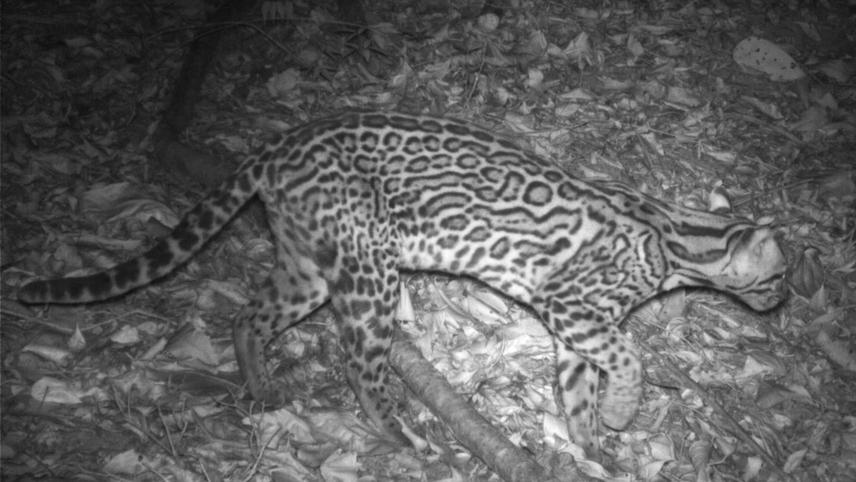
Ocelot (Leopardus pardalis) photographed by a camera trap in the Chaguaramas Peninsula, Trinidad. (c) Tyler Murray-Ramcharan
This project aims to establish the first coordinated ecological baselines for ocelots in Trinidad while strengthening local capacity for long-term wildlife monitoring. Using non-invasive camera trap surveys, we will estimate ocelot density, occupancy, and activity patterns across two sites: the Chaguaramas Peninsula in north-west Trinidad and the rural forest landscape of Brasso Seco in the Northern Range. These sites differ in land use, human pressure, and connectivity, providing an opportunity to understand how ocelots persist across a fragmented and human-dominated landscape.
In parallel with ecological monitoring, the project places strong emphasis on community engagement and participation. Practical training workshops will be conducted with local communities, students and volunteers focusing on camera trap deployment, field data recording, and digital workflows for wildlife monitoring. By involving communities directly in data collection and interpretation, the project aims to build awareness of ocelots, reduce human–wildlife conflict, and foster local stewardship of forest ecosystems.
The data generated through this work will directly support evidence-based conservation planning by national authorities, including the Environmental Management Authority and Forestry Division. In addition, the project will establish a simple, user-friendly data pipeline that allows continued reporting of wildlife encounters beyond the life of the grant, supporting sustained monitoring efforts.
By combining rigorous ecological research with capacity building and community participation, this project seeks to lay the scientific and social foundations needed to conserve Trinidad’s last wild cat and the forest ecosystems it represents.