Mirella Baldacconi Gondeck


Other projects
12 Jan 2024
Distribution Patterns of Frugivorous Butterflies (Papilionoidea: Nymphalidae) Metacommunities in Atlantic Forest Fragments on the Santa Catarina Island - Sc, Br

The Atlantic Forest is one of the most biodiverse yet highly threatened ecosystems on Earth. On Santa Catarina Island, southern Brazil, forest remnants face increasing pressures from urban expansion, tourism, and habitat fragmentation. Butterflies, particularly fruit-feeding species, are widely recognised as sensitive ecological indicators and can reveal how habitat quality and connectivity shape biodiversity patterns.
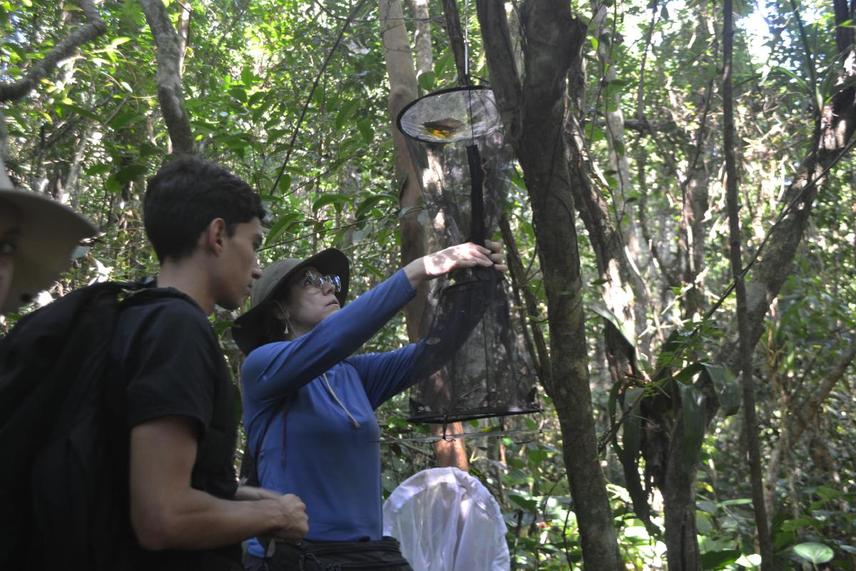
Fieldwork in the Atlantic Forest - researcher and field assistant checking a Van Someren-Rydon trap used for sampling fruit-feeding butterflies along the Caminho da Gurita trail © Larissa Santos
This project aims to evaluate the effects of habitat structure, forest connectivity, and landscape composition on fruit-feeding butterfly communities, adopting a metacommunity ecology framework. By integrating ecological field surveys, landscape analysis, and community engagement, the project will provide novel insights into biodiversity responses to environmental change while strengthening conservation strategies at both local and regional scales.
Fieldwork will be carried out in twelve sampling stations across the island, each including altered (forest edge) and conserved (interior) environments. Standardised baited traps will be used to sample butterfly communities over multiple campaigns, complemented by measurements of vegetation structure, local temperature and landscape metrics such as forest cover, edge density, and patch connectivity. The data will be analysed to assess richness, abundance and beta-diversity in relation to environmental gradients.
Beyond ecological research, the project strongly emphasises capacity building and public engagement. Undergraduate students from the Federal University of Santa Catarina will be trained in ecological monitoring, insect curation, and statistical analysis, ensuring the next generation of conservation scientists. In parallel, a butterfly house will be established at Parque do Córrego, a public urban green space managed by the municipal environmental foundation FLORAM. This facility will provide live rearing, guided visits, and environmental education for schools and local residents, fostering direct contact with biodiversity and environmental awareness.
The project will also produce an illustrated butterfly identification guide to support citizen science initiatives, encouraging the use of platforms such as iNaturalist for spontaneous monitoring. By combining scientific data, education, and public participation, in the long term the project aims to institutionalise butterfly monitoring as a continuous conservation tool on the island.
Ultimately, this initiative will deliver both robust ecological knowledge and tangible community benefits. The results will inform local management plans, strengthen ecological connectivity, and create opportunities for corporate partnerships. In doing so, the project seeks to contribute not only to butterfly conservation but also to the broader protection of the Atlantic Forest and its invaluable biodiversity.