Loreta Carolina Facciano


Patagonian forests face critical challenges from climate change, with extensive dieback and tree mortality resulting from extreme droughts and heatwaves. These ecosystems sustain ecologically and culturally important species such as Fitzroya cupressoides (Endangered – IUCN) and Pilgerodendron uviferum (Vulnerable – IUCN), monotypic conifers endemic to Argentina and Chile that are threatened by logging, grazing, fire, and drought; Austrocedrus chilensis (Near Threatened – IUCN), a dominant conifer experiencing scattered mortality; and Nothofagus dombeyi (Least Concern – IUCN), which—despite its current classification—has shown the most pronounced mortality and decline across the region in recent years.
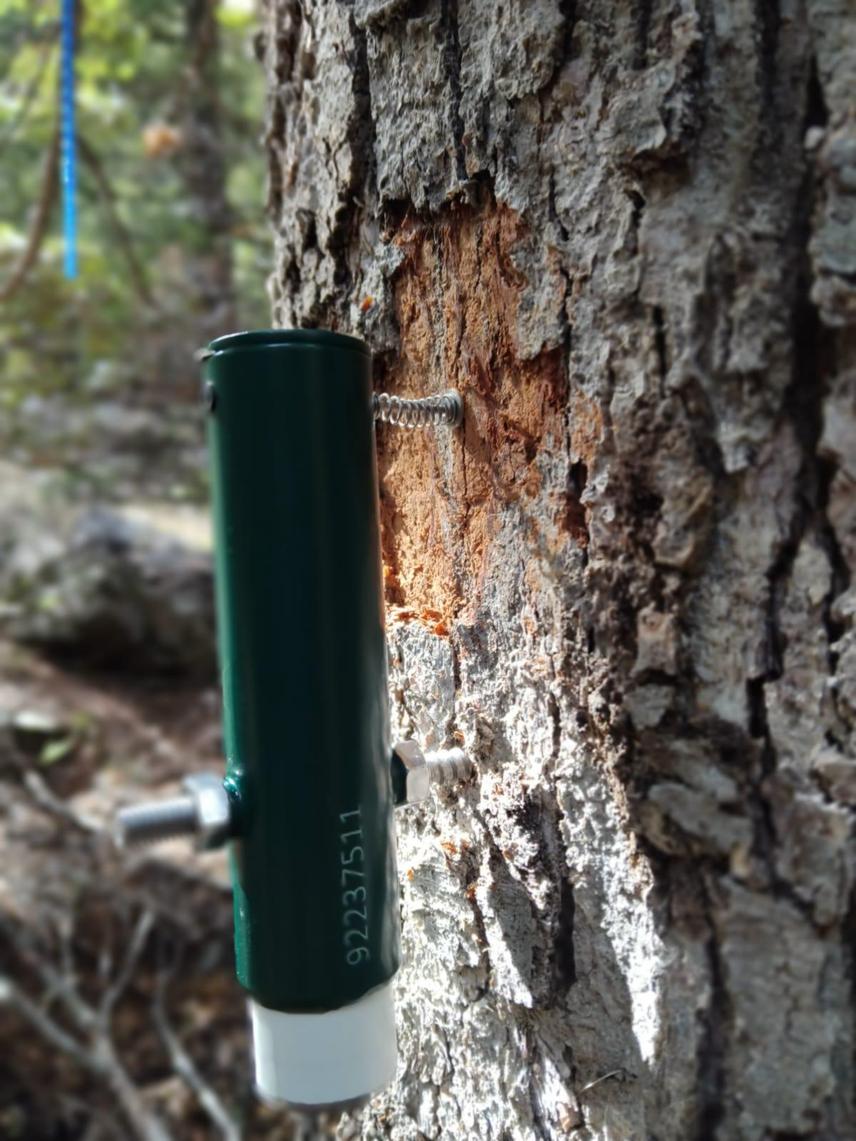
Point Dendrometer device on tree. © Maria Laura Suarez.
This project offers a timely opportunity to consolidate scientific efforts to document and understand forest dieback within Nahuel Huapi National Park (PNNH). By integrating ecological surveys and long-term monitoring data, it aims to strengthen conservation and management strategies that enhance forest resistance and resilience under increasing climatic stress.
The main objective is to monitor the conservation status of Patagonian Andean forests through a combination of ecological assessments and citizen-powered observations of climate-driven tree dieback. Increasingly frequent and severe droughts threaten the structure, function, and long-term adaptive capacity of these temperate forests, endangering the many ecosystem services they provide, regulate, and support. By engaging citizens alongside scientists in active monitoring of tree health, this initiative will generate updated vulnerability and risk maps for key forest species, assess the spatial extent of dieback at the National Park level, and empower local communities to become active participants in forest research and conservation.
To achieve these aims, the project will implement the following actions:
1) Install point dendrometers on dominant adult individuals to obtain high-resolution growth data.
2) Monitor, control, and collect monthly measurements of secondary growth and associated climatic conditions.
3) Obtain increment cores for dendrochronological analysis to assess growth patterns and climate–growth relationships.
4) Map tree mortality in the surveyed species to evaluate the spatial extent and intensity of dieback.
5) Conduct outreach and educational talks for schools and citizen volunteers involved in forest monitoring, promoting
6) Compile tree growth data and develop audiovisual materials to communicate forest monitoring techniques and project outcomes to broader audiences.
Through this integrated scientific and participatory approach, the project seeks to foster long-term conservation of Patagonian forests facing unprecedented climatic pressures.