Hugo Sánchez Gómez


Other projects
24 Mar 2023
Biological and Socio-Economic Assessment of Elasmobranch Fisheries in Costa Grande Guerrero, México

This project aims to evaluate recruitment resilience in a shark nursery ground in Bahías de Papanoa, Guerrero, Mexico, using genomic data, and assesses whether community-led fisheries management can support sustainable recruitment. Nursery areas are critical habitats for sharks, as they sustain high densities of juveniles whose survival determines future population persistence.
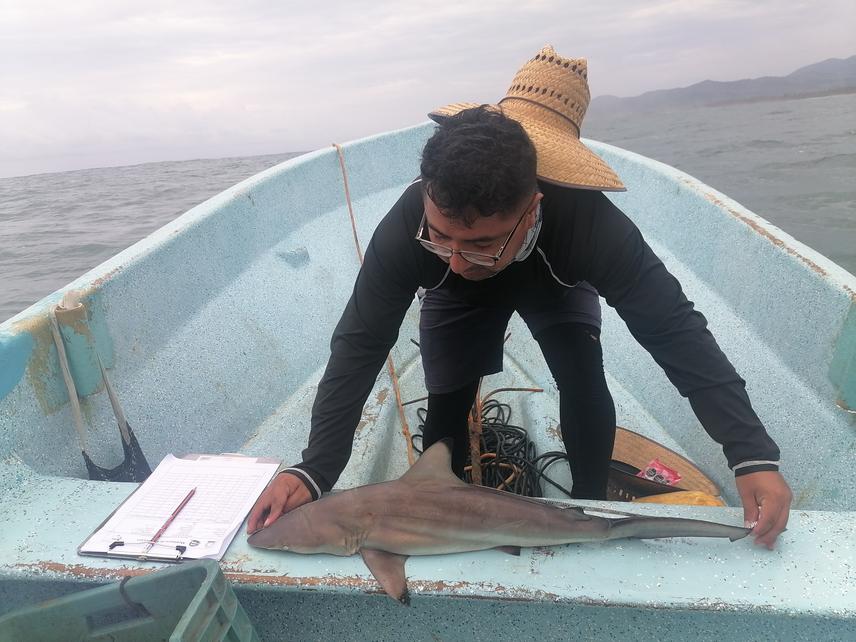
Hugo Sánchez Gómez (Team Leader) measuring a young-of-the-year blacktip shark (Carcharhinus limbatus) in Bahías de Papanoa, Guerrero, Mexico. © Alejandro Esquivel
Building on our previous Rufford-funded project, we identified this area as an important multi-species nursery ground for the scalloped hammerhead (Sphyrna lewini) and the blacktip shark (Carcharhinus limbatus). Local fishers in Puerto Vicente Guerrero have implemented voluntary conservation measures, including prohibiting gillnets and surface longlines and avoiding the capture of large adults. While these practices may reduce juvenile mortality and protect breeding individuals, their effectiveness remains untested.
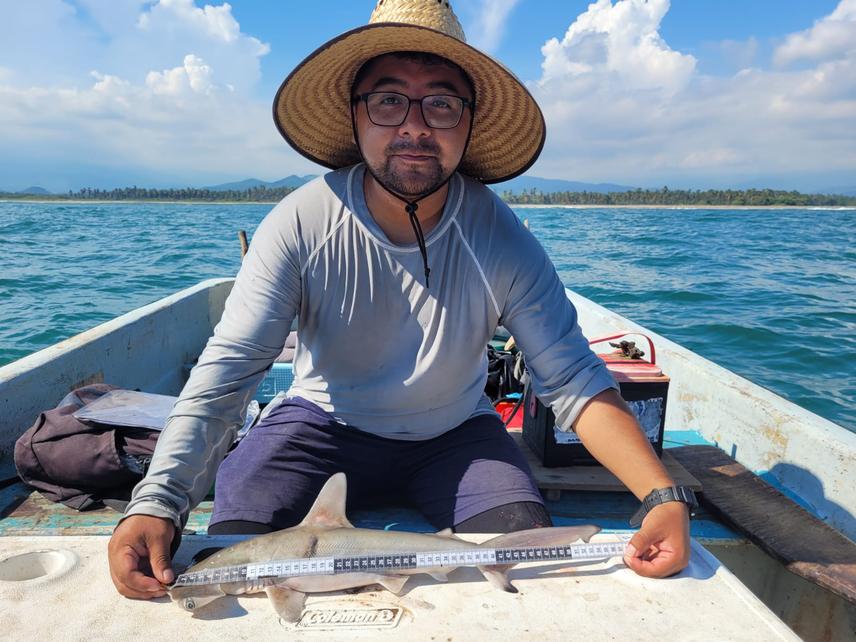
Hugo Sánchez Gómez (Team Leader) measuring a neonate scalloped hammerhead shark (Sphyrna lewini) in Bahías de Papanoa, Guerrero, Mexico. © Alejandro Esquivel
To address this, we will estimate the effective number of breeders (Nb), defined as the number of individuals that successfully contribute offspring to each cohort. Nb provides a direct measure of recruitment dynamics and allows us to evaluate whether reproduction is broadly distributed among adults or dominated by a few individuals. In addition, we will reconstruct kinship relationships among juveniles to quantify patterns of parental contribution and variance in reproductive success within each cohort. Together, these analyses characterize contemporary reproductive dynamics and the stability of recruitment.
Field sampling will be conducted in collaboration with local fishers, followed by DNA extraction and ddRAD sequencing to generate genome-wide SNP data. Results will be shared through participatory workshops to strengthen local capacity for incorporating biological information into management decisions.
Ultimately, this project will provide the first genomic assessment of recruitment dynamics in a shark nursery in the Mexican Pacific and test whether community-based management can maintain a sufficient number of effective breeders. These findings will directly inform evidence-based conservation and evaluate the potential for replicating this model in other regions.