Grilante Beva


Other projects
20 Apr 2022
Trial of Seagrass Restoration Techniques in Ranobe Bay, Southwest of Madagascar

21 Feb 2024
Effectiveness for Communities-Based Seagrass Restoration in Ranobe Bay, Southwest of Madagascar
In Ranobe Bay, southwestern Madagascar, seagrass meadows cover approximately 2,900 hectares and host nine seagrass species. These ecosystems provide vital goods and services for marine biodiversity and play a crucial role in supporting food security and livelihoods for coastal communities. Seagrass meadows serve as blue carbon ecosystems, storing up to 15% of the ocean’s total carbon and making a significant contribution to climate change mitigation.
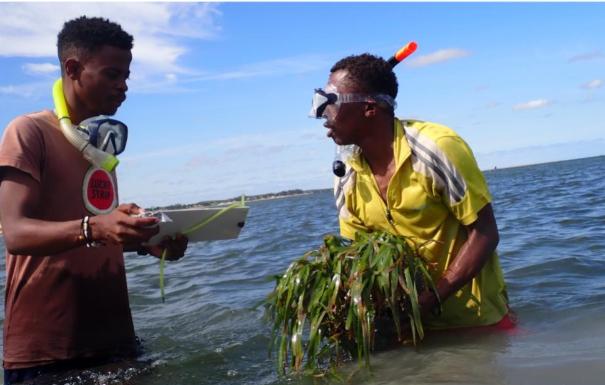
Community leading seagrass transplantation in Ifaty, Ranobe Bay, southwestern Madagascar © Grilante Beva, 2024
Despite their importance, seagrass meadows in the Ranobe bay are increasingly threatened by multiple pressures, including destructive fishing practices (such as the use of mosquito nets), unregulated aquaculture and farming activities, trampling, pollution, and the growing impacts of climate change, particularly extreme events such as cyclones.
In response to these challenges, seagrass conservation and restoration initiatives were launched in Ranobe Bay in 2022, focusing on testing seagrass transplantation and awareness-raising on the impacts of seagrass degradation to marine biodiversity and local community livelihood. Recently, the effectiveness of community-based seagrass restoration approaches has been assessed in the region. Building on these efforts, the present project aims to strengthen local capacity to lead seagrass conservation and restoration actions in Ranobe Bay, which is essential for ensuring long-term sustainability.
Key activities include extensive awareness-raising campaigns, training local communities in participatory ecological monitoring, and capacity-building in seagrass restoration techniques such as transplantation and seedling nurseries. In addition, the project seeks to establish a community-managed conservation area (“No-Take Zone”) to reduce pressure on seagrass meadows and associated marine resources.
Expected outcomes include raising awareness to more than 500 fishers on the ecological and socio-economic importance of seagrass meadows and the benefits of its conservation, delivering environmental education to 500 schoolchildren around the Ranobe bay, training 20 local leaders to lead seagrass restoration and monitoring activities, expanding seagrass restoration efforts to 2 hectares of degraded meadows, and establishing 20 hectares of seagrass meadows as a No-Take Zone. This area will be protected under a local governance framework (DINA), ensuring the sustainable conservation of seagrass ecosystems and their associated biodiversity. This project will develop a replicable, community-based model for the protection, restoration, and long-term conservation of seagrass ecosystems in Madagascar and beyond.