Facundo Leonel De Los Santos

Darwin's diabolic toad (Melanophryniscus diabolicus) is a species of dark-colored toad with red and yellow spots, daytime, recently described, microendemic to the highland grasslands of the Sierras de Ventania mountain range and has not yet been catalogued by the IUCN or at the national level. The grasslands where it inhabits are severely fragmented because almost all of the land in this region has been converted to cropland. Invasive woody species and livestock represent a major threat, even within Protected Areas.
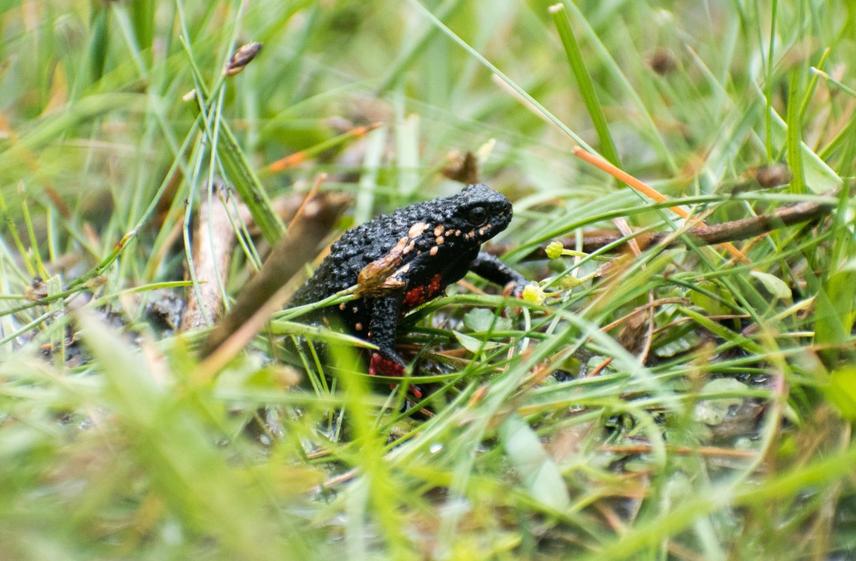
Darwin’s diabolic toad (Melanophryniscus diabolicus) adult male showing the characteristic dark coloration with red markings, photographed in its natural habitat in Sierra de la Ventana. © Facundo L. De los Santos, 2025
Roads not only increase mortality from roadkill, but also restrict movement between breeding habitats, reducing connectivity between populations. A field study estimated that roadkill causes an annual mortality of up to 5.9% of a population. Darwin's diabolic toad has a limited range, reported to occur in “no more than three localities”.
A model based on a suitable climate predicted more than a 60% decline in area by 2080, and ranked Darwin's diabolic toad among the three high-priority conservation species in the genus. Given the absence of previous conservation actions for Darwin's diabolic toad, this project represents a pilot initiative to test and evaluate effective management strategies, such as the creation of a sanctuary fenced, successfully tested for other endangered amphibians, and the installation of amphibian tunnels, a pioneering technique in South America with proven high effectiveness in Europe and the United States. The results will provide essential guidance for scaling up future interventions and conservation planning for the species.