Wong Jieyi


Other projects
31 May 2024
Population Status of Common Seahorse, Hippocampus Kuda, in the Urban Seagrass Meadow of Merambong Shoal

A seahorse population assessment was initiated in 2023, post-development adjacent to Merambong Shoal seagrass meadow, and received support from Rufford Small Grant in 2024. Following from the first stage of the grant, this study would like to extend the research to better understand long-term population trends of spotted seahorses (Hippocampus kuda) at the area, as two years of data remain insufficient to capture reliable patterns. During these surveys, epibionts such as marine leeches and gastropods were observed latched on the seahorses encountered. However, their frequency of occurrence, species identity, and potential ecological relationships remain unknown. Building upon these initial findings, this project seeks to continue population monitoring while incorporating an additional investigation into epibiont associations, thereby broadening the understanding of seahorse health and ecosystem dynamics.
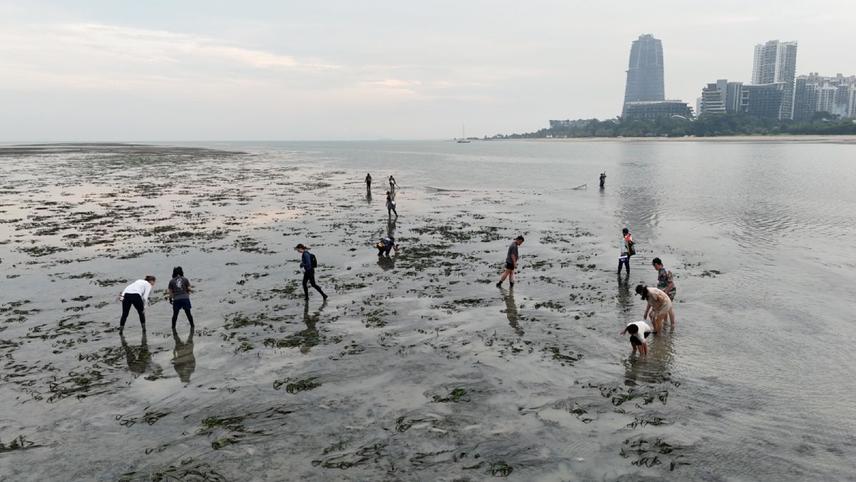
Participants and the Save Our Seahorses Malaysia team searching for seahorses across the seagrass bed during low tide at Merambong Shoal © Leh Kah Meng
Merambong shoal, located between Forest City, Johor, and Tuas, Singapore, is one of the largest seagrass meadows and mangrove habitats in the country. The shoal consists of mainly the tape seagrass Enhalus acoroides and the ribbon seagrass Cymodocea serrulata. Other marine organisms can also be found in habitats such as sea stars, sea cucumbers, shrimps, and pen shells. However, it is increasingly impacted by coastal development. Land reclamation, pollution, and seawall construction have altered the habitat, causing sedimentation, loss of shorelines, and degraded water quality.
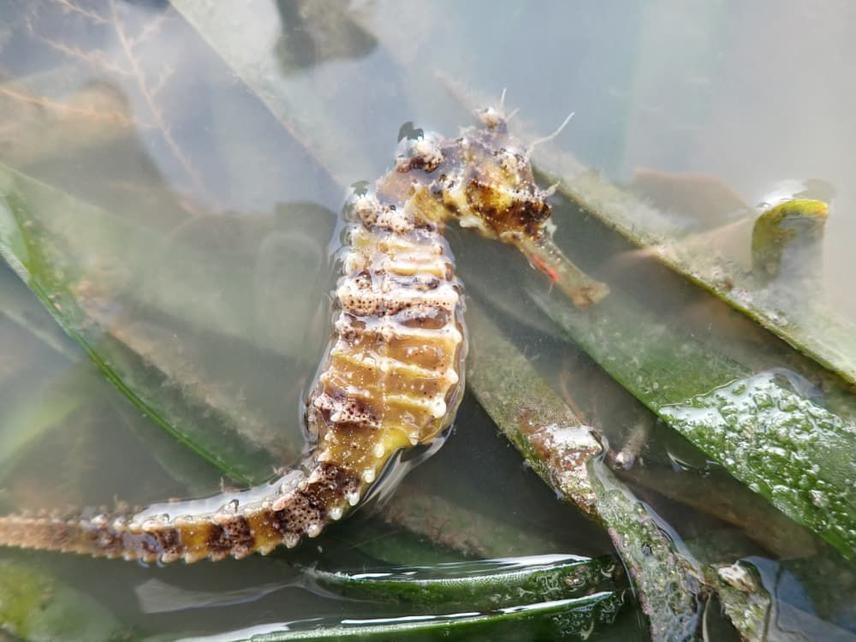
A female spotted seahorse (Hippocampus kuda) observed with an unidentified blotch on the facial region © Save Our Seahorses Malaysia.
Although seahorses and seagrasses are highly sensitive to environmental conditions like pH and oxygen levels, this study does not include direct environmental measurements due to the site’s geopolitical sensitivity. Instead, seahorses are used as biological indicators of ecosystem health. The local coastal community also depends on the seagrass ecosystem for food and income.
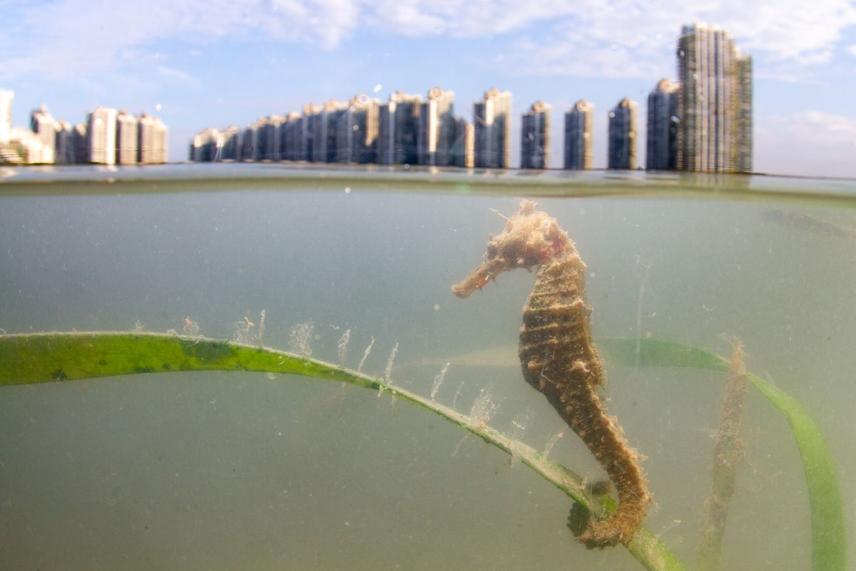
A spotted seahorse (Hippocampus kuda) inhabiting the urban seagrass meadow, Merambong Shoal - Scott Patrick Nishiki
Despite its ecological importance, little research has explored the current status of H. kuda at Merambong shoal. A previous tagging study (2007–2014) provided baseline data but only covered a certain part of the habitat. The population changes since the rapid development (2014–2023) remain unknown. Furthermore, the relationship between seahorses and epibionts, such as parasitic leeches, remains understudied in Malaysia.
Understanding these interactions is essential, as parasites can impact seahorse health and survival. Therefore, this project aims to continue and expand the long-term monitoring of H. kuda using mark-recapture methods and to investigate epibiotic associations, helping to assess the impacts of urbanisation on this vulnerable species and its habitat.