Vinay Chandnani

Dhanauri Wetlands, located in Gautam Buddha Nagar, Uttar Pradesh (UP) is a significant habitat for the vulnerable Sarus Crane (Antigone antigone) on the periphery of the expanding Delhi-National Capital Region. Located along the Central Asian Flyway, it is home to over 200 bird species and has historically hosted one of the largest congregations of the Sarus Crane in India.
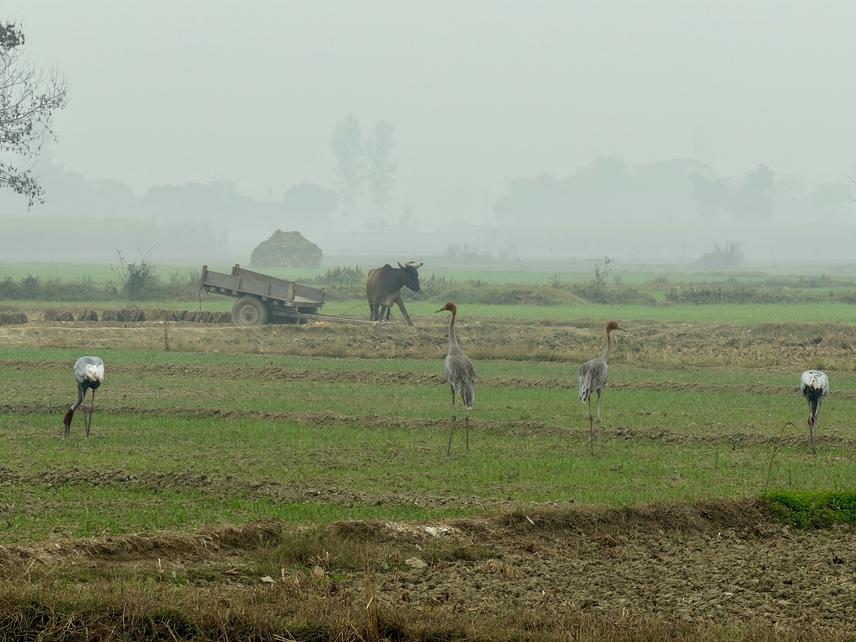
Four Sarus Cranes foraging on agricultural land in the winter smog, as a bull cart works the field alongside them © Vinay Chandnani
However, the Asian Waterbird Census has recorded a 52% decline in bird numbers at the wetland between 2022 and 2024. In addition to an international airport not more than 20 kilometres away, the land around the wetland has been acquired for the construction of residential complexes and a highway as part of the development of the area into the new Yamuna Expressway Industrial Development Authority (YEIDA) City.
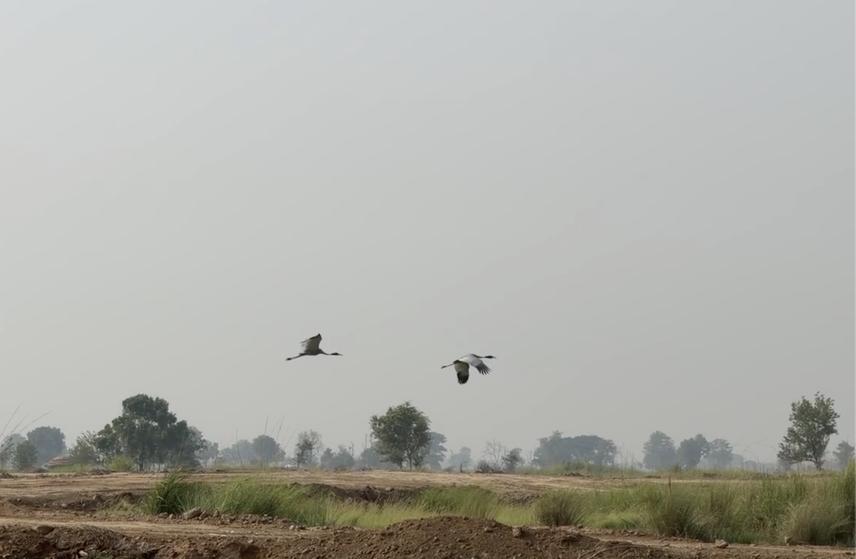
A pair of Sarus Cranes flying over the construction site on the edges of the wetland © Vinay Chandnani
Despite its ecological significance, Dhanauri holds no formal protected area status: a proposal to designate the site as a Ramsar Site was rejected by the UP state government, which has instead proposed a Biodiversity Park model. This designation carries no legally binding conservation protections or limitations on construction activity, while the rules governing community access to the wetland, including grazing rights, fishing rights, and land use, are yet to be determined.
The three villages surrounding the wetland are home to farming and pastoral communities whose livelihoods are tied to the wetland. Primary ethnographic research conducted over the summer of 2026 revealed that a drainage channel was blocked approximately a decade ago, creating permanent flooding around the wetland that has made post-monsoon farming impossible for families whose land borders the wetland. Conservationists have benefited from a perennially flooded wetland while farming communities have borne the costs – with no compensation or consultation.
This project, hosted by the Wildlife Trust of India, returns to Dhanauri’s communities to address this gap. The aim of this project is to conduct community feedback sessions to share research findings, to assess the feasibility of participatory conservation structures including village wetland management committees and community monitoring networks, and to co-create a field guide to the species of Dhanauri in Hindi and English.
While construction activities are already underway, there is still a window for meaningful community participation in the design of the Biodiversity Park. To this end, the project also aims to deliver a conservation recommendation report to local authorities and NGOs, outlining community access rights for resources that are quickly being reappropriated for urban development.