Nimna Sesadhi Wickramasingha

Artisanal fisheries are vital to Sri Lankan coastal communities, particularly where economic alternatives are limited. These fisheries use diverse practices across lagoon, coastal, and deep-sea habitats, capturing a wide array of species, including mobulid rays and endangered sharks. Many of these species are protected under international frameworks like CITES and CMS. However, limited large-scale monitoring capacity hinders accurate population assessment, while national schemes, such as logbooks and observer programmes, often miss illegal, unreported, and unregulated (IUU) fishing and the trade of protected species.
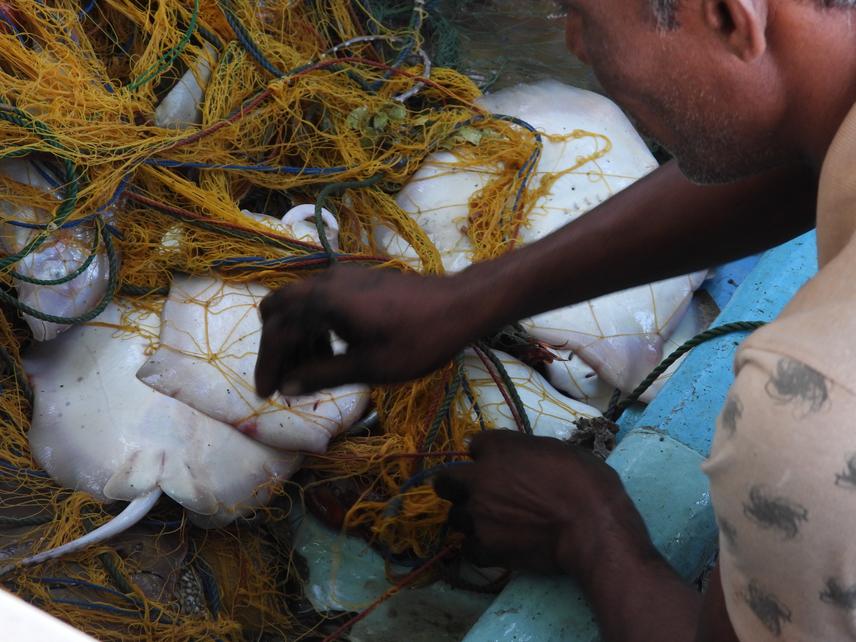
Fisher untangling blue-spotted stingrays from the gillnet while removing poisonous barbs © Rahal Rabukpota (BRT)
This project, in partnership with University of Leeds, UK, and Blue Resources Trust (BRT) (https://www.blueresources.org/), applies environmental DNA (eDNA) techniques to monitor chondrichthyan catch at the artisanal landing site of Peththalai in Batticaloa, a hotspot for threatened species such as the stripenose guitarfish (Acroteriobatus variegatus). eDNA offers a powerful complementary tool to traditional surveys, enabling the detection of species through the residual DNA shed by organisms into the environment, including cryptic or discarded species that may be missed visually.
We will deploy metaprobes, custom-made rolls of gauze tied to perforated spheres, to capture eDNA in two ways: attached to gillnets during deployment to sample surrounding water, and placed in boat holds to collect eDNA from wastewater after net retrieval. Additionally, eDNA will be extracted from washings of the weighing scales used for landed catch. By applying metabarcoding techniques, we aim to improve detection of chondrichthyan species, generating comprehensive biodiversity inventories. This method increases spatiotemporal data collection, allows for accurate genetic identification, and can be implemented independent of fishing schedules. It will help validate national data collection schemes, improve population assessments, inform targeted conservation measures, replacing blanket bans with data-driven strategies, such as catch limits and seasonal fishing bans, that balance biodiversity protection and community livelihoods.
Project Aims:
1. Demonstrate the reliability of boat hold wastewater, gillnet deployments, and scale washing as eDNA sources for bycatch monitoring.
2. Optimise protocols from sampling to primer selection and amplicon generation.
3. Compare eDNA-based species inventories with observational records to assess metabarcoding effectiveness and evaluate carry-over risk to determine eDNA detection origin.
4. Engage fisheries managers by presenting findings to national agencies and discussing the feasibility of resource allocation for eDNA integration into monitoring frameworks.
Through stakeholder engagement and the application of cutting-edge molecular tools, this project supports improved chondrichthyan detection and data-driven management, promoting the conservation of threatened marine species while recognising the socio-economic importance of artisanal fisheries.