John Gitogo


Other projects
25 Aug 2021
Building Local Capacity in Conservation of Endangered Grey Crowned Crane in Nyandarua County, Kenya

The Grey Crowned Crane, Kenya’s national bird and a globally endangered species, has suffered a 50- 79% population decline over 45 years due to wetland destruction, poaching, and human-wildlife conflict (IUCN, 2023). Nyandarua County’s Lake Ol’ Bolossat and Kinangop Plateau—hosting 11.7% of Kenya’s remaining cranes face acute threats from agricultural encroachment, invasive species, and unsustainable water use, exacerbated by limited conservation investment in these privately owned landscapes. Over 200,000 smallholder farmers and pastoralists depend on these ecosystems, yet crop damage by cranes fuels retaliatory killings, while wetland degradation undermines water security and livelihoods. Our team, with 8 years’ + experience in Nyandarua through the Friends of Kinangop Plateau, has demonstrated success in community-based conservation—establishing 200 acres of grassland reserves and an Eco-Resource Centre while training 120 local stewards.
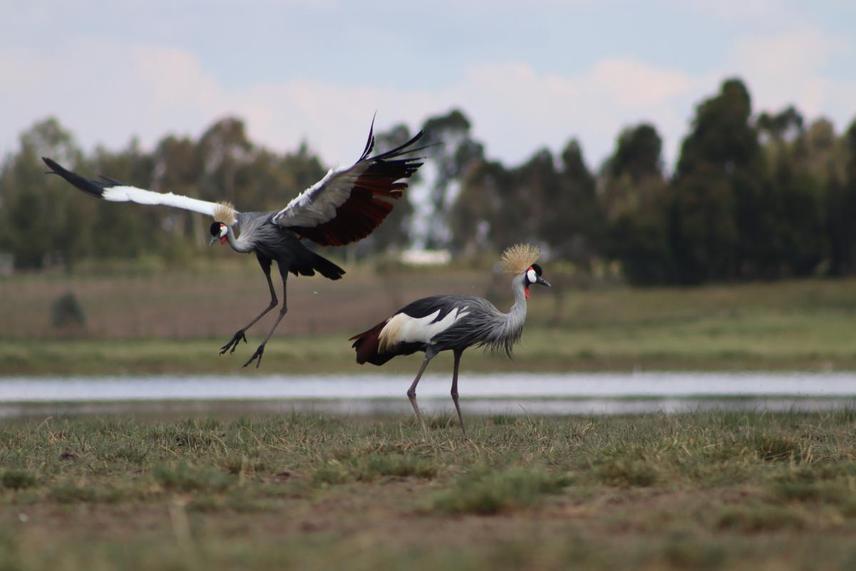
Image of Gray crowned crane © Martin Mwangi
This project expands our proven model by addressing systemic gaps: lack of economic alternatives driving habitat loss, absence of coordinated monitoring, and policy enforcement weaknesses. By integrating crane conservation with climatesmart livelihoods (biochar/briquettes from invasive species, crane-friendly farming) and innovative financing (carbon credits, eco-tourism), we will protect 1,200 hectares of critical habitat while directly benefiting 500 households through diversified incomes. Our deep community partnerships, technical expertise in avian conservation, and collaboration with KWS and Nature Kenya position us uniquely to deliver scalable impacts—preventing this iconic species’ slide toward extinction while strengthening community resilience in Kenya’s most vulnerable crane strongholds. This project directly advances six Sustainable Development Goals (SDGs) by addressing the intertwined crises of biodiversity loss and rural poverty in Nyandarua County, Kenya. It aligns with SDG 15 (Life on Land), SDG 6 (Clean Water), and SDG 13 (Climate Action). Simultaneously, it supports SDG 8 (Decent Work) and SDG 1 (No Poverty) by creating sustainable livelihoods, while SDG 17 (Partnerships) underpins collaboration with communities, government (KWS), and NGOs.