Jacques Assumani


Nestled in the highlands of South Kivu, in eastern Democratic Republic of Congo, the wetlands of Nyamubanda, Kashanja, and Nkombo form a true mosaic of life, essential both for local communities and for biodiversity. These marshes, located within the Albertine Rift region, harbour a remarkable diversity of amphibians, including, but not limited to, Phrynobatrachus asper and Leptopelis karissimbensis, two species listed as Vulnerable. Yet these fragile ecosystems are gradually disappearing under the pressures of agricultural expansion, agrochemical pollution, deforestation, and unregulated resource use - threats that also endanger the livelihoods of rural communities that depend on them for farming, water, and food security.
Amphibians, key indicators of ecosystem health, are rapidly declining here, but no in-depth study has ever documented their status. This project aims to fill that gap by conducting the first ecological baseline survey of amphibian populations and their habitats in the Walungu wetlands, while simultaneously mobilizing local communities to ensure their protection.
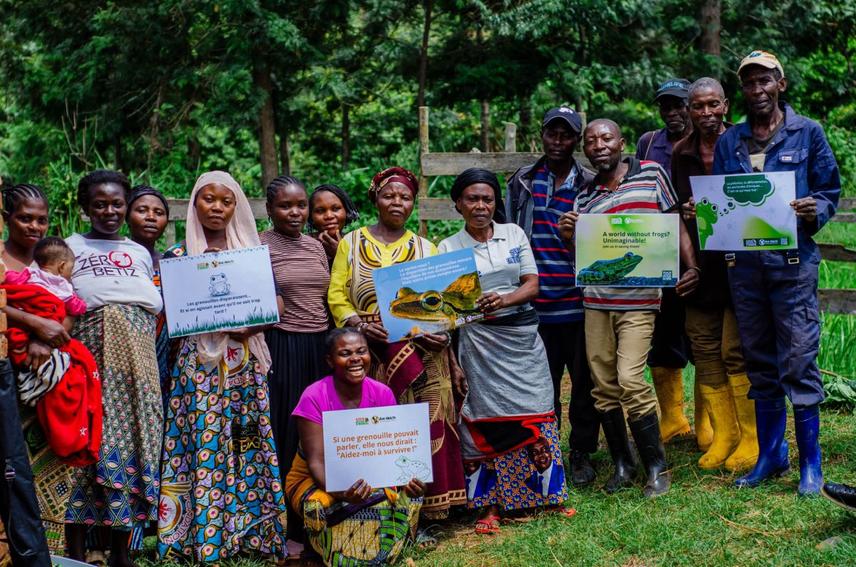
Image taken after raising awareness among farmers in Mbobero (Kabare Territory) about protecting frogs in their marshes. © Jacques Assumani / 2024 Save the Frogs Day
Fieldwork will combine visual encounter surveys and transect walks to assess species diversity, abundance, and distribution. GPS mapping and habitat evaluations will identify breeding and refuge areas, while data on water quality and vegetation will inform ecological management. In parallel, the project will emphasize education and community participation through awareness workshops, school outreach activities, and participatory mapping with farmers and youth, strengthening collective responsibility for conservation.
Two community monitoring groups will be created and trained to observe amphibian presence and wetland health beyond the project’s duration. Demonstration plots in sustainable agriculture will help reduce agricultural encroachment and pesticide runoff, aligning biodiversity protection with improved living conditions.
The results will provide the first reliable baseline data on amphibians in this region and guide future conservation policies. Ultimately, this project seeks to transform neglected wetlands into living laboratories of hope, where science meets community leadership to protect the hidden voices of the forest - the frogs that keep our ecosystems alive.