Chinemerem Ikechukwu Godwin


Other projects
19 Jan 2021
Historical Appraisal of the Diversity of Amphibians and Threats to their Conservation Across Nigeria

The Old Ndebije Hill is an unprotected community owned forest. It is one of the intact moist rainforest hills in south-east Nigeria with records of divers and unique floras and faunas. Amphibian declines are currently one of the most compelling conservation issues, and during my previous site visits, I observed that montane forest amphibian at the Old Ndebije Hill face imminent extinction due to the ever-increasing demand for arable land to grow cocoa, poaching due to demand for meat protein, tree logging for wild honey harvesting and timber trade.
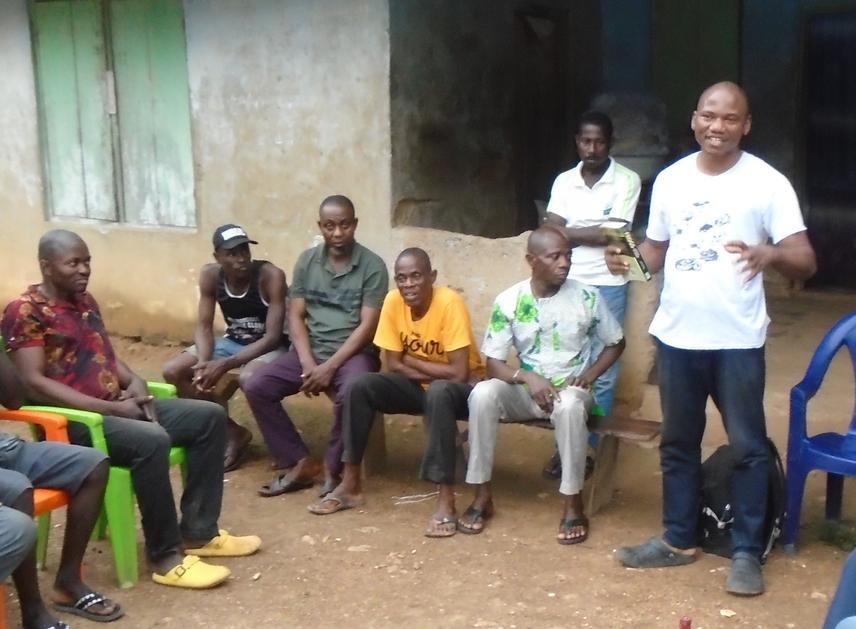
Amphibian conservation Education talk with Old Ndebije Community leaders © Kenneth Ekun (team member)
In the midst of all these, the paucity of data on these threatened amphibians and lack of conservation education about these species makes the development of any long-term conservation program extremely difficult.
This project wishes:
1. To provide an updated information on the population, distribution and habitat preference of the threatened amphibians of Old Ndebije Montane Forest.
2. Raise awareness among school children and members of the community on the need to conserve the amphibians of the hill and protect the hill forest.
3. Train members of the community on artificial pollination of cocoa plants so as to improve crop yield on existing cocoa farms and discourage clearing Old Ndebije Montane Forest for new farm establishment.
4. Train the people on sustainable beekeeping and donate some beehives and accessories to the people to discourage tree felling and unsustainable wild honey harvesting in the forest, and promote insect pollination for improved crop yield.
During this project, I will be collecting field data on the population, distribution and habitat preference of the threatened amphibians of the hill, and I will also record other interesting plant and animal species encountered during my field work.
This information will be sent to the Nigerian Conservation Foundation and the IUCN Nigeria Species Survival Commission, for the designation of the site as Key Biodiversity Area (KBA). Aside from designating the Old Ndebije Hill as a Key Biodiversity Area, through this project’s conservation awareness campaign we hope to make the site a community protected forest as we work with the indigenous people and other stakeholders to actualize this.