Andrés Valenzuela Sánchez


This project will implement urgent recovery actions for the Endangered southern Darwin’s frog (Rhinoderma darwinii) across the Austral temperate forests of southern Chile, building on more than a decade of Rufford-supported research, conservation planning and partnerships.
Darwin’s frogs are among the world’s most evolutionarily distinctive amphibians and are the only amphibians known to brood tadpoles inside the male’s vocal sac. However, they are threatened by habitat loss and degradation, and by chytridiomycosis, a disease caused by the invasive fungus Batrachochytrium dendrobatidis (Bd).
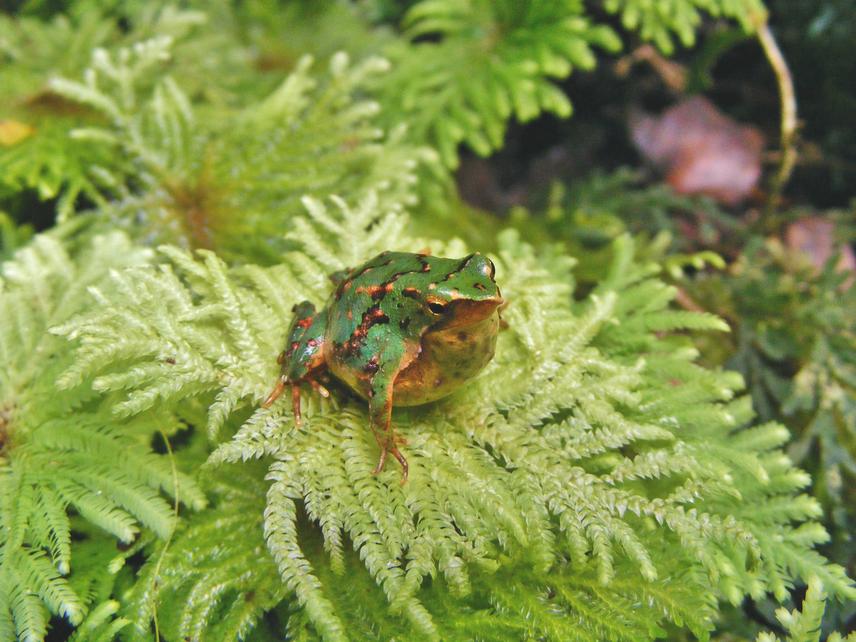
A brooding male Darwin’s frog from Tantauco Park, southern Chile. Populations of the species in this area, once considered a stronghold for the species, collapsed following the invasion of the chytrid fungus in 2023 (c) NGO Ranita de Darwin
The project combines four complementary approaches. First, in Parque Tantauco, Chiloé Archipelago, where Bd recently invaded one of the most important known strongholds for the southern Darwin’s frog, we will strengthen in situ disease mitigation, biosecurity and monitoring. This will include maintaining field exclosures designed to reduce contact between Darwin’s frogs and potential Bd reservoir species, and monitoring frog abundance, occupancy, and infection status in priority areas of the park.
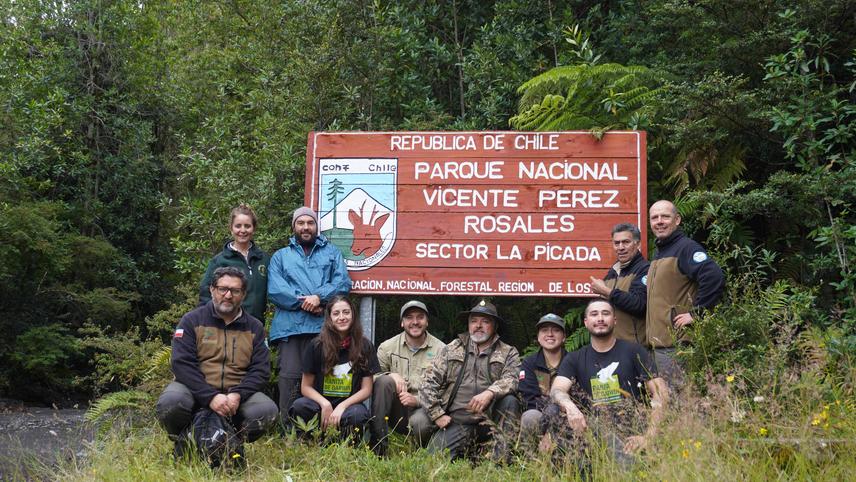
Capacity-building workshop on amphibian monitoring with rangers from Parque Nacional Vicente Pérez Rosales (c) NGO Ranita de Darwin
Second, the project will strengthen long-term habitat protection on private lands through NGO Ranita de Darwin’s frog-friendly land conservation programme. We will review and monitor existing conservation agreements, work with landowners to improve frog-friendly habitat management, and incorporate additional priority landowners, extending protection to native forest habitats and Darwin’s frog populations.
Third, the project will build capacity among protected-area staff, park rangers and partner institutions, including public and private protected areas such as Parque Nacional Vicente Pérez Rosales. Training will focus on amphibian monitoring, animal welfare, habitat protection and field biosecurity, helping partners apply improved conservation practices across key forest landscapes.
Finally, the project will support implementation of the Binational Conservation Strategy and Chilean RECOGE plan for Darwin’s frogs by coordinating partners, sharing technical evidence and communicating conservation priorities to stakeholders and the wider public. Together, these actions will protect remnant populations, improve habitat management, strengthen local capacity and support the long-term recovery of Darwin’s frogs and the threatened Austral temperate forests they inhabit.