Sydney-Marie Jones

The charismatic Grey Parrot (Psittacus erithacus) has suffered estimated population declines of 50-79% over recent decades, driven by illegal capture for the pet trade and widespread deforestation. Despite global recognition of Grey Parrots’ vulnerability—the species is listed as Endangered on the IUCN Red List and included in CITES Appendix I—wild populations in West and Central Africa remain poorly studied.

Lodi Michel paddling a dugout canoe through heavily burned Grey Parrot nesting habitat. (© Sydney-Marie Jones)
Located in the Democratic Republic of the Congo’s Maniema Province, Lac Ndjale hosts one of the largest recorded breeding aggregations of Grey Parrots in the country—and likely in the species range. A 2015 expedition by the Lukuru Foundation first introduced the area to the scientific community, documenting both an extraordinary concentration of breeding parrots and extensive harvesting of hatchlings. In the decade since, a combination of shifting economic pressures, federal anti-poaching legislation, and growing local concern has created new opportunities for community-based conservation and long-term ecological research.
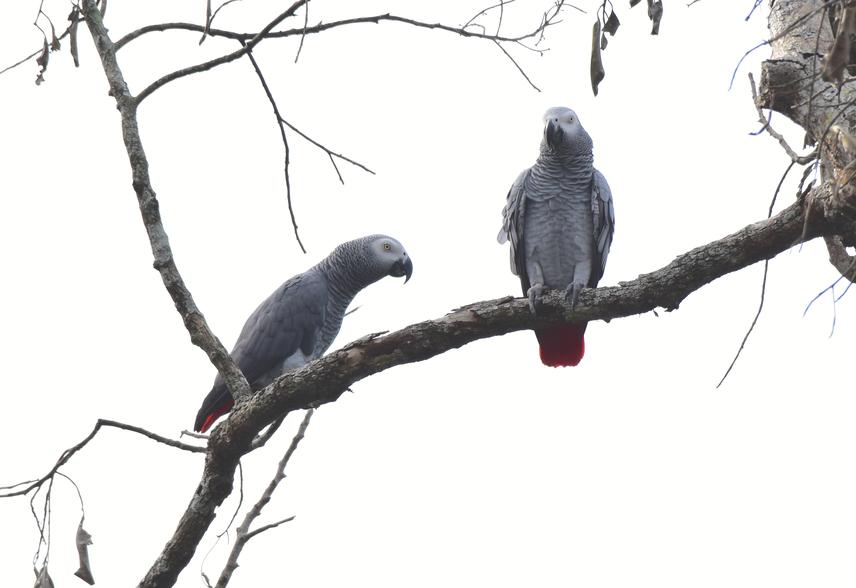
A pair of Grey Parrots along the Kasuku River, DRC, photographed during nest surveys in the area (© Sydney-Marie Jones)
Working alongside the DRC-based Lukuru Foundation, this project’s main aims are to: (1) characterize Grey Parrot nesting habitat at Lac Ndjale; (2) improve understanding of the population’s seasonal dynamics; (3) begin to formally document Lac Ndjale’s avifaunal diversity; and (4) establish local infrastructure and partnerships for long-term population monitoring. All work will leverage the expertise of local communities—particularly fishermen and former parrot traders from the neighbouring groupements of Yenge and Wondo, whose knowledge of parrot behaviour, density, and threats long predates Lukuru’s 2015 reconnaissance.
Extent and composition of Grey Parrot habitat will be determined using transect-based surveys of parrot activity, combined with a spatially comprehensive cataloguing of all known nest trees. Surveys will prioritize identifying boundaries of the breeding aggregation, characterizing preferred habitat and vegetation composition, and defining the extent of a particularly destructive 2024 fire in the region. Autonomous Recording Units (ARUs) will be deployed within and outside of the aggregation to understand daily—and eventually seasonal—cycles of Grey Parrot behaviour. In addition to establishing Grey Parrot presence and absence, ARUs will support the identification of Lac Ndjale’s broader avian community, which has never been systematically studied. Following initial data collection and information gathering, a systematic and long-term monitoring program at Lac Ndjale will be established. This process will prioritize local concerns and will be locally led following an initial training period.
Overall, this project will provide foundational ecological data and partnerships necessary to protect of the DRC’s most threatened and emblematic bird species.