Marsya Christyanti Sibarani

Other projects
8 May 2019
Conservation Camp: Training Young Conservationists for the Future of Indonesian Biodiversity

Small apes (family Hylobatidae) are canopy-dwelling primates that are primarily frugivorous and play vital roles in forest regeneration as seed dispersers. While most species are allopatric, siamangs coexist with ecologically similar lar or agile gibbons, which can lead to interspecific competition. The relative role of interspecific competition and how it interacts with anthropogenic disturbances in shaping extinction risk remains poorly understood.
This is especially important for endangered species like small apes, for which baseline population data are still lacking in most of their ranges. These gaps limit our ability to make informed conservation decisions to address questions such as: How does habitat disturbance facilitate or impede species coexistence? Should conservation prioritize areas with relatively high densities of both species despite potential competition, and areas with lower densities of each species?
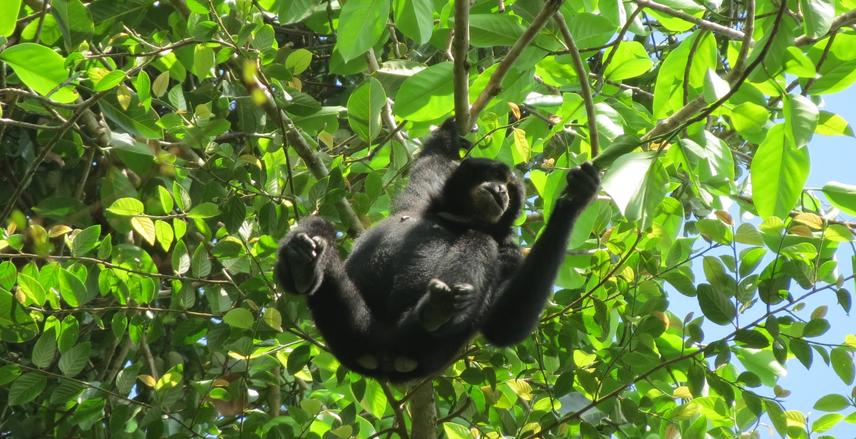
Siamang (Symphalangus syndactylus) feeding. © Marsya Sibarani
This project will address these questions by assessing the population status of siamangs and agile gibbons, as well as the environmental factors influencing their populations in the Batang Gadis Ecosystem, a biodiversity-rich but under-studied landscape in Sumatra. The term "Batang Gadis Ecosystem" encompasses Batang Gadis National Park and its surrounding Protection Forests and Limited Production Forests which serve as buffer zones.
This project will fill significant knowledge gaps regarding the population status and conservation priorities for siamangs and agile gibbons, while building capacity among park staff and university students through training in population monitoring and habitat assessment techniques.
The baseline data generated on population density, along with the identification of key ecological and anthropogenic drivers, will be integrated into park management planning to ensure conservation actions are evidence-based and locally relevant. Ultimately, this project aims to strengthen local capacity and identify priority habitats to reduce the extinction risk for small apes.
The expected outcomes of this project are:
1. Establishment of baseline population for small apes in the Batang Gadis Ecosystem
2. Enhanced capacity of local stakeholders to monitor small ape populations
3. Maps for priority habitats for small ape conservation
4. Integration of small ape conservation into park management plan document