Faizan Ahmad


Our project, “Asiatic black bear conservation in the Hindu Raj Mountain Range, Pakistan: investigating distribution, population trends, and conflict dynamics,” will generate the first integrated, year-round evidence base needed to conserve the Vulnerable Asiatic black bear (Ursus thibetanus) and reduce human–bear conflict in Swat and across the wider Hindu Raj. Once more widespread, the species now persists in fragmented forest landscapes where habitat loss, poaching of cubs, and retaliatory killings intersect with real costs borne by pastoral and farming communities through livestock depredation and crop damage. By coupling rigorous ecological monitoring with community-led solutions, the project will close critical information gaps and build local capacity for coexistence.
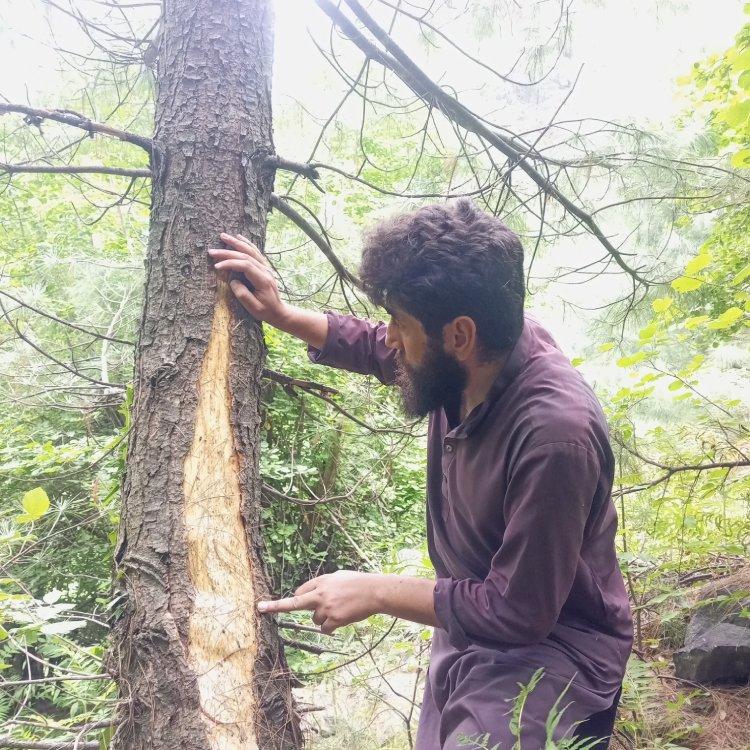
Bark peeling observed on a Pinus wallichiana tree—likely a result of bears foraging for cambium or bark-dwelling insects. © Faizan Ahmad
We have four main aims.
(1) Map spatiotemporal distribution and seasonal altitudinal movements by integrating presence data from camera traps and sign surveys with environmental predictors in species distribution models, producing habitat-suitability maps to guide protection and restoration.
(2) Estimate population density via a year-long camera-trapping program analysed with Random Encounter Models, establishing a reproducible baseline for future trend monitoring.
(3) Quantify spatial and temporal overlap among bears, sympatric wildlife (e.g., common leopard, grey wolf, goral, markhor, rhesus monkey, leopard cat, Asiatic jackal, Indian crested porcupine, red fox) and anthropogenic activity (people, livestock, dogs) to understand coexistence mechanisms and inform site-level management.
(4) Identify and map human–bear conflict hotspots by combining structured community surveys with GIS-based hotspot analysis, then co-design practical, non-lethal mitigation tailored to local livelihoods.
Fieldwork will stratify the Hindu Raj study area into 2 × 2 km grid cells (4 km²) for systematic, year-round camera deployment, complemented by sign surveys and semi-structured interviews. Stakeholder engagement prioritizes the Khyber Pakhtunkhwa Wildlife Department (KPWD) and communities most affected by conflict. Outputs will include open-access habitat and conflict-risk maps, population density estimates, peer-reviewed publications, and policy briefs. Targeted workshops will train KPWD officers and community partners in modern monitoring tools (camera trapping, GIS, species distribution modelling) and cost-effective livestock and crop-protection measures. Together, these actions will institutionalize evidence-based management, reduce conflict incidents, and deliver co-benefits for other threatened species that share bear habitats—creating a durable platform for long-term conservation in one of Pakistan’s most important mountain ecosystems.