Anamaria Rozo


This project aims to evaluate the vulnerability and adaptive capacity of five endemic and culturally important páramo and superpáramo plant species to climate change through participatory monitoring involving rural school students, campesino communities, and park rangers from El Cocuy National Natural Park (CNP), located in the Colombian Andes. Three experimental nurseries will be established along an altitudinal gradient: one existing high-elevation nursery at 4,000 m, and two new school-based nurseries at “La Cueva” (3,564 m) and “El Cardón” (3,642 m), in the municipalities of Güicán de la Sierra and El Cocuy. These nurseries will function as living laboratories for environmental education and research on climate change adaptation.
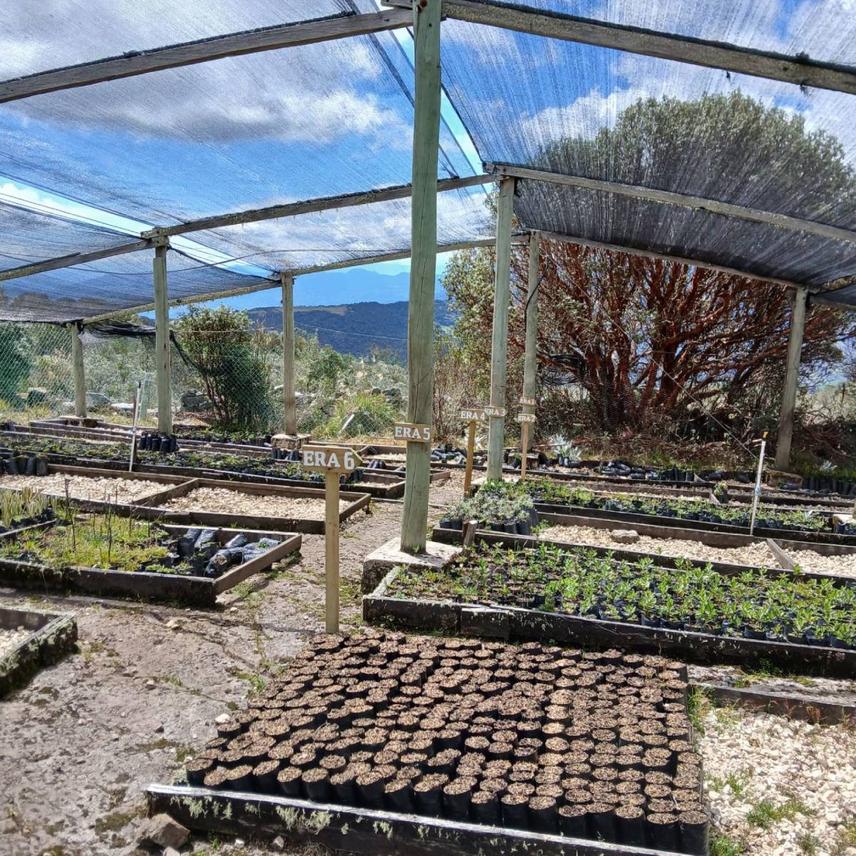
El Cocuy National Natural Park Nursery at 4000m © Anamaría Rozo, 2025
Objective 1: Evaluate the physiological and morphological responses of plant species to increased temperature (between 2.5 and 3.5°C), altered precipitation, and varying levels of solar radiation. The focal species include Polylepis quadrijuga (Critically Endangered), Espeletia lopezii (frailejón), Linochilus revolutus (a medicinal shrub), Draba litamo (a medicinal herb associated with “eternal youth”), and Senecio formosus (a medicinal herb commonly known as árnica). Differential responses are expected among species, depending on their growth forms and ecological strategies.
Objective 2: Strengthen environmental education on climate change by engaging rural students, teachers, and park rangers in the monitoring of plant growth and physiological responses. Through participatory experiments, the project seeks to promote understanding of climate change impacts on páramo ecosystems and strengthen local connections to the territory. This approach will foster experiential learning, ecological awareness, and the development of local adaptive capacities, forming a new generation of students capable of integrating traditional and scientific knowledge.
Objective 3: Recover and promote the transmission of traditional ecological knowledge related to the use and propagation of native plants. Intergenerational exchange spaces will be organized, where campesino leaders and park rangers share their knowledge with students, strengthening the propagation of medicinal species such as Draba litamo and Senecio formosus.
Objective 4: Integrate school nurseries into the environmental education and conservation strategies of El Cocuy National Natural Park, ensuring their long-term sustainability and alignment with ecological restoration processes and evidence-based decision-making derived from the project’s findings.