Agbatan Marc Koutchoro


Other projects

3 Mar 2025
Development of Agropastoral Alternatives to Promote the Propagation of Afzelia africana in Benin, a Species Threatened with Extinction
Afzelia africana is a highly valued woody species in Benin for its ecological and socio-economic importance, but it is threatened by overexploitation, intensive pruning, low natural regeneration, and ongoing habitat degradation (Dossou et al., 2025; Koutchoro et al., 2026). In rural and periurban areas, the high demand for fodder during the dry season leads herders to cut branches from adult trees, compromising their survival and the species’ regeneration. In response, during our 2nd RSG, we developed an innovative technique for producing fodder biomass in nurseries, providing a sustainable alternative to branch cutting.
Moreover, results from our 1st RSG showed that despite the presence of beneficial traditional practices (Koutchoro et al., 2026), human pressure remains high and natural regeneration is still insufficient. These findings highlight the need to transition from the experimental phase to large-scale community adoption.
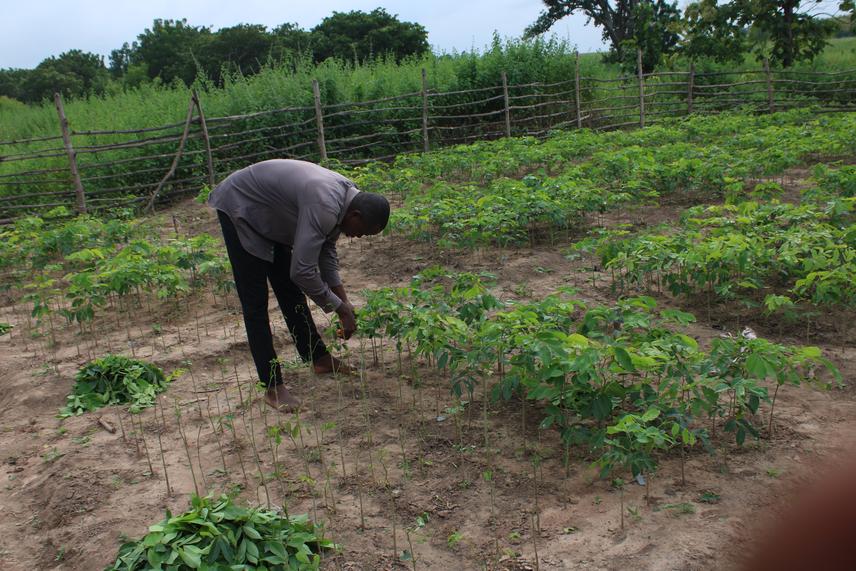
Fodder biomass production in nurseries using Afzelia africana © Koutchoro (2025)
This project represents the next phase by scaling up these successful pilot interventions through community-based implementation around the Ouémé Supérieur Gazetted Forest in Benin. Its main objective is to accelerate the conservation and propagation of Afzelia africana by promoting sustainable restoration practices and reducing pressure on natural populations. Specifically, the project will train local communities in nursery-based fodder biomass production techniques using Afzelia africana, enabling livestock keepers to meet dry-season fodder needs without damaging mature trees. It will also strengthen the propagation of the species through reforestation in schools, household compounds, degraded forest habitats, and agroforestry systems. In parallel, environmental education and awareness campaigns will promote sustainable natural resource management and encourage greater community participation in biodiversity conservation.
A key innovation of the project is the development of an effective vegetative propagation protocol using stem cuttings. This research will improve the large-scale production of planting material, overcoming current limitations associated with seed availability and germination, and providing a practical tool for future restoration programmes.
By integrating applied research, ecological restoration, environmental education, and community participation, the project will enhance the long-term conservation of Afzelia africana, improve ecosystem resilience, reduce pressure on threatened habitats, and strengthen the capacity of local communities to sustainably manage one of Benin's most important native tree species. The project's technical and scientific outputs will be disseminated through training materials, outreach activities, and open-access scientific publications to maximize their long-term impact and replicability.