Oki Hidayat


The Flores Hawk-Eagle (Nisaetus floris) is one of Indonesia’s rarest raptors and the only island-endemic eagle in the country. Despite its 2024 IUCN classification as Endangered, its true conservation status remains uncertain because no rigorous population estimate has ever been conducted across its strongholds. Preliminary observations indicate that the species remains exceptionally scarce in Mount Rinjani (Lombok) and Mount Tambora (Sumbawa) National Parks—two key habitats increasingly threatened by forest encroachment, agricultural expansion, prey decline, and occasional persecution. The absence of science-based data continues to hinder effective species recovery and habitat management.
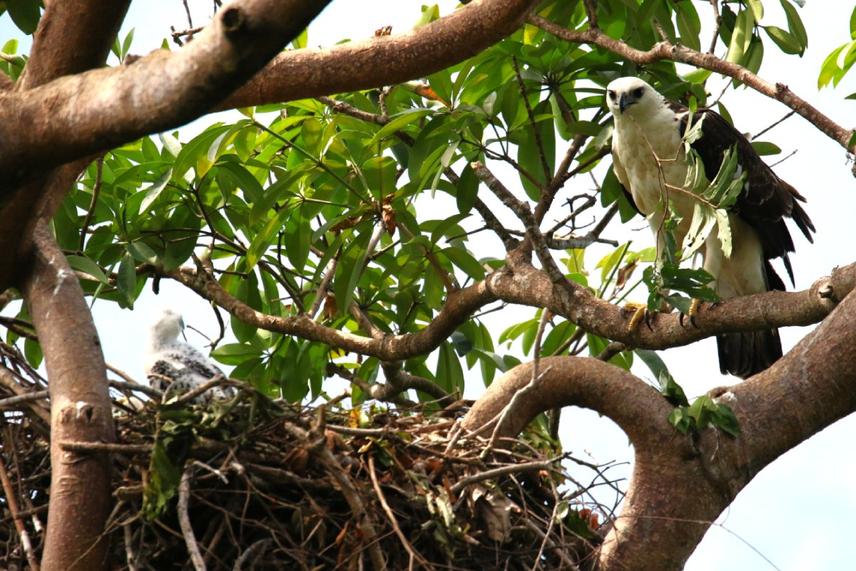
In the Otoeso customary forest, Flores Island, a Flores Hawk-Eagle returns to its nest with nesting material as its chick waits inside — a rare glimpse of parental care in one of Indonesia’s most elusive raptors. © Oki Hidayat
This project seeks to generate the first robust population assessment and home-range analysis of the Flores Hawk-Eagle in these two national parks. Through systematic field surveys, nest monitoring, and the deployment of four GSM-based GPS transmitters, we will map the distribution, movement patterns, and habitat requirements of adult eagles. These spatial data will then be combined with land-use and threat analyses to identify priority conservation zones, including nesting sites, high-use foraging areas, and human-driven disturbance hotspots.
A core aim of the project is to translate scientific research into practical, policy-relevant conservation action. By working closely with park management authorities, the Nature Resources Conservation Agency), and local government, we will integrate telemetry results into improved park zoning, targeted patrol routes, and habitat protection strategies. The project will also build conservation capacity at the community level by training local rangers, birdwatchers, and youth conservationists in raptor monitoring techniques and nest-finding methods. Their participation will create a locally sustained monitoring network that remains active beyond the grant period.
Ultimately, this project will deliver ecological data that are urgently needed to support evidence-based conservation planning for the Flores Hawk-Eagle and the wider montane forest ecosystems of the Lesser Sunda Islands. By combining cutting-edge spatial research, legal and ethical compliance, and community-centered approaches, the project will contribute to long-term species recovery while strengthening local stewardship of protected areas that are vital to both biodiversity and surrounding human livelihoods.