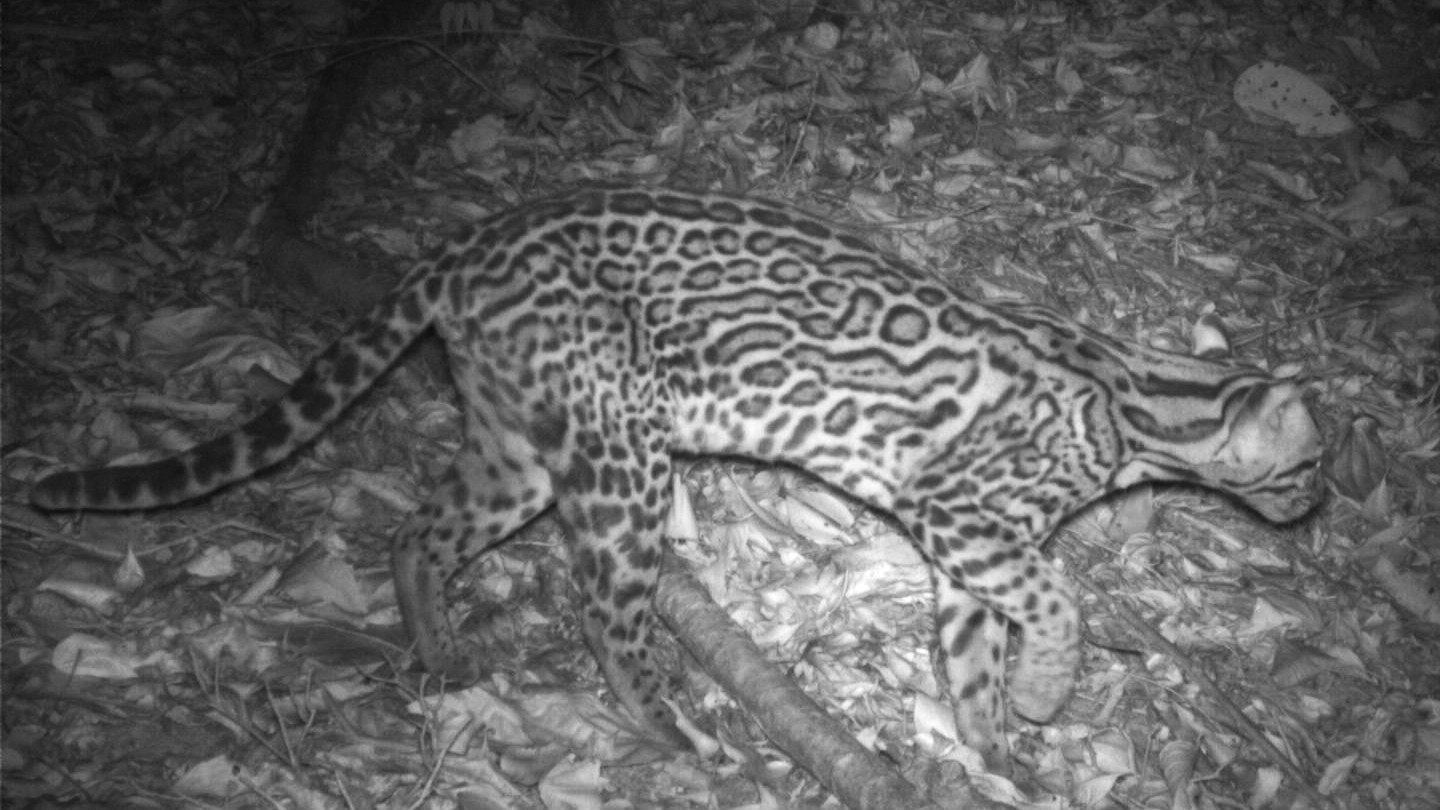
Ocelot (Leopardus pardalis) photographed by a camera trap in the Chaguaramas Peninsula, Trinidad. ©Tyler Murray-Ramcharan
Small wild cats move through some of the world’s most fragile and contested landscapes, often unseen and overlooked in comparison to larger felids. From fishing cats navigating wetlands in Nepal to African golden cats moving through Uganda’s forests, these species face mounting pressures, both ecological and human driven. Habitat fragmentation, roads, agricultural expansion and snaring continue to threaten their survival, while limited research and funding mean many small felids remain underrepresented in global conservation priorities. Yet across the world, conservationists are developing practical, community-focused approaches that reflect the subtle and highly localised nature of small cat ecology.
These efforts were championed during the Small Cats Symposium 2026, a virtual gathering bringing together researchers, conservationists, students and wildlife professionals from across continents. The symposium created a platform for sharing research, discussing emerging threats and highlighting the value of collaboration between science and local communities. Throughout the event, a recurring message emerged: successful small cat conservation depends not only on ecological knowledge, but also on understanding the social and economic realities of the people living alongside these species.
The Rufford Foundation participated in the symposium, with Grants Officer Jo Cook joining a panel discussion on what funders look for when supporting conservation projects, and how small cat conservation can attract more funding. Jo comments, “The symposium provided an excellent opportunity for professionals from around the world to connect, exchange knowledge and learn from one another. It was also encouraging to see growing awareness of the importance of small cat conservation.”
Several Rufford grantees presented their work at the symposium, including Tyler Murray-Ramcharan, a researcher addressing a major knowledge gap surrounding Trinidad’s ocelots (Leopardus pardalis), a small, isolated population serving as the country’s apex terrestrial predator. Using camera trap surveys across the Chaguaramas Peninsula and the Brasso Seco forests, the project will establish the first ecological baseline for ocelots, providing insights into population status, habitat use and response to human activity. There is also strong emphasis on community participation, equipping residents, students and volunteers with wildlife monitoring skills, thus building local stewardship and long-term conservation support.
Tyler says, “As someone starting a small cat conservation initiative, the symposium was an invaluable opportunity to learn from projects working with different species, in different regions and at various stages of development. The experience helped shape my thinking about the future direction of my own work, while the strong sense of community was particularly inspiring. Small cats are often overlooked in conservation, so connecting with others dedicated to their protection was incredibly encouraging. I left with new contacts, potential collaborations and a stronger sense of being part of a global effort to conserve these remarkable species.”
Another attendee, Ganesh Puri, has dedicated his career to reducing conflict between people and threatened carnivores, particularly fishing cats (Prionailurus viverrinus), in Nepal. A Forest Officer with the Ministry of Forest and Environment, he combines scientific research with community-based conservation initiatives. In 2020, Ganesh founded the Western Terai Fishing Cat Conservation Project, engaging local fishing communities in fishing cat conservation. One initiative, the Fish Bank Project, transforms tensions between fishing cats and fish farmers into opportunities for coexistence, while his research on wildlife crime, illegal trade and habitat suitability informs conservation policy and practice.
%20WTFCP.jpg) Fishing cat with prey ©WTFCP
Fishing cat with prey ©WTFCP
Other Rufford supported small cat projects include Badru Mugerwa’s work in Uganda’s Bwindi Impenetrable National Park. Here, snares set for hunting bushmeat indiscriminately injure and kill many species, including the elusive African golden cat (Caracal aurata). Badru’s work combines long-term ecological monitoring with community-led initiatives that tackle economic drivers behind poaching, complementing enforcement efforts.
In Argentina, Laura Alvarez Borla, investigates human pressures affecting native carnivores in and around Nahuel Huapi National Park, a key refuge for the kodkod (Leopardus guigna) and Geoffroy's cat (Leopardus geoffroyi). Using camera traps and dietary analysis, her project compares carnivore populations in protected and unprotected areas to understand habitat use and species interactions. Laura’s team works with communities and stakeholders to develop practical, science-based conservation actions that support the long-term protection of Patagonia’s unique carnivore species and their habitats.
Combined, these efforts demonstrate how science and community engagement can create lasting foundations for protecting wild cats and their habitats, a recurring theme throughout the symposium.
The work presented at Small Cats Symposium 2026 demonstrated conserving small wild cats is about far more than protecting individual species. These animals are indicators of healthy wetlands, forests, and agricultural landscapes, and their survival is closely tied to the wellbeing of the communities living alongside them. The projects highlighted throughout the symposium offered a vision of conservation that is evidence-based, locally grounded and shaped through partnership — a model that may prove essential for the future of small cat conservation worldwide.
To view the recording of the talks, please follow the link below: Small Cats Symposium 2026 Recordings