Adriana Bravo

Frugivorous Bats and Collpas: Activity Hotspots as Conservation Priorities for the Rainforests of Southeastern Peru

LocationCountryCategoriesDate
Los Amigos Conservation Concession, Madre de DiosPeruBats, Central and Latin America, Mammals28 Feb 2008

Frugivorous bats play a fundamental role in tropical ecosystems. In the Peruvian Amazon, frugivorous bats visit collpas, open areas in the forest where the soil is exposed. Nightly, large numbers of bats arrive to drink the water accumulated in collpa depressions created by larger geophagous animals, such as tapirs and white-lipped peccaries. Although bats visitation to collpas is a common behaviour, very little is known about this phenomenon. The goal of my research is to document in detail the use of collpas by bats, study its seasonality in relation to the bats’ breeding season, and conduct experiments to determine what are the specific resources that bats are seeking at collpas. Based on this information, I want to determine the importance of collpas as conservation priorities for the Peruvian Amazon.
For more information contact abravo1@lsu.edu

Project Update: March 2008

This is Adriana Bravo, a Rufford grantee working with bats and mineral licks or collpas in the Peruvian Amazon.
I am writing to let you know that things are doing great down here in Los Amigos Biological Station in Madre de Dios, Peru.

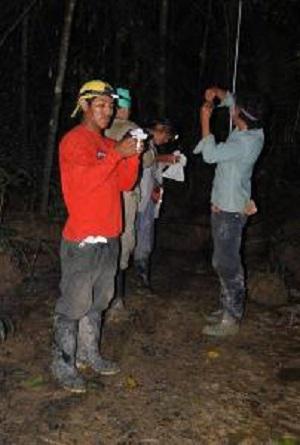
This first month of work, we have been camping and traveling all over the concession (up stream) and we finally finished our first round of bat captures.

We, my two volunteers and a local assistant, have visited the three sites where we captured bats and collected water samples. Everything was excellent. We captured many bats at the collpas, or mineral licks, and less in the forest and gaps as expected.

Yesterday we participated in the environmental program of the station and we talked to the children about bats and their role as pollinators. It was awesome.

Project Update: May 2008

On May 10, we finished sampling bats on our three sites along the Los Amigos River in the Concession. I was a great field season! We have caught over 600 bats.

The last week of sampling, however, there was a cold front in the area (Patagonian cold winds reaching the southeastern Peruvian Amazon!). Therefore, we had really cold days (minimum temperatures falling to ~13 C) and bats' activity was very slow. So, we had to wait a little bit to let the bats to warm up again and sample. But besides that little change in the environment everything was great. Now, I am going to a meeting in Suriname to present some results.


Other Projects in: