Luis Rivera

This project will study the ecology, reproductive biology and conservation of Alder Amazon (Amazona tucumana) in the Montane Forests of Argentina
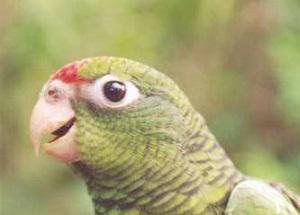
Alder Amazon. ©Luis Rivera.
Alder Amazon (Amazona tucumana) is an endemic parrot species that inhabits the montane cloud forest of North-western Argentina and Southern Bolivia (called Yungas) for which its ecology and reproductive biology are unknown. The Yungas is the only habitat where Alder Amazon occurs, and is a rich biodiversity region with many endemic species that are disappearing rapidly. Sixty percent of the Yungas have already been lost due to transformation, timber harvesting, and overgrazing.
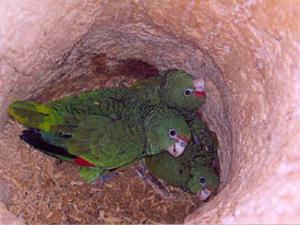
Alder Amazon nestlings inside nest. ©Luis Rivera.
Population numbers for Alder Amazon in Argentina have decreased dramatically due to past capture for the pet trade and habitat loss. This highlights the importance of understanding ecological an reproductive requirements since it seems that the species has not been able to recover. It is essential to understand how habitat alterations affect Alder Amazon’s populations, which can only be achieved with information on productivity, nest success, and breeding habitat requirements. Additionally, there is a need to understand the relationship of parrot population to food resources to determine key resources, habitats, and areas required for conservation.
Intensive searches in El Rey National Park will be conducted to identify Alder Amazon nests. El Rey National Park contains the last mature forest remnant of Argentina. Nests will be identified by observation of breeding pairs behaviour and inspected and monitored with a camera system attached to an extensible pole (i.e., tree-peeper). The diet of Alder Amazon throughout the year will be determined by direct observation of feeding activity. Additionally, we will establish phenology transects throughout the study area and collect information for all seasons of the year to relate the abundance of food resources with those consumed by Alder Amazon.
The management guidelines for the area can will be based on the habitat requirements of Alder Amazon and will serve to set baseline information to manage forests outside protected areas. For example, these guidelines will include recommendations that potential cavity-nest trees (trees of preferred species above certain size thresholds) be retained in harvested forests. Additionally, the conservation education campaign that is already underway will be broadened to include more schools in remote areas that contain populations and habitat of Alder Amazon.