Diti Mookherjee

Programme to conserve the urban biodiversity of Kolkata City with school students.

LocationCountryCategoriesDate
IndiaBiodiversity, Indian Sub-continent2 Dec 2004

For one year we will work intensively in 15 schools in Kolkata with students of Classes 7 and 8 (age group 12 to 14 years). The students will view a slide-illustrated talk on “Biodiversity of Kolkata” followed by an interactive session. After this 25 students will be chosen to form the core team along with two teachers. This core team will, in the next three months, be taken on a nature walk around their school premises, involved in nature games and discussions and taken for a visit to a biodiversity hotspot close to Kolkata city. In the fifth month, the core team will formulate a project to conserve the biodiversity of Kolkata in a manner that they can so as to make a sustained impact.
The Project will be led by Diti Mookherjee, who has been working on environmental education for the last 22 years and is presently the Chief Executive Officer of Association for Social and Environmental Development (ASED), a non-profit organization working on action-based awareness to enhance environmental conservation and community health in West Bengal, India. She will be assisted by the team from ASED consisting of Kushal Mookherjee, a naturalist who has been involved with environmental education for 25 years. He is the Secretary of Prakriti Samsad, a leading environmental conservation organization based in Kolkata and a member of the National Board for Wildlife, India and the State Wildlife Advisory Board. The other team member is Samya Basu, who is presently working for his Masters Degree in Environmental Science and helping ASED with its environmental education programs.

This program team will work closely with the core team for successful implementation of the project for the next 7 months. In this time the core team will have sufficient exposure to motivate other students in the school and work on nature awareness and conservation issues in future. They will be assisted in networking with concerned other organisations and government departments so that they can access information and seek assistance for their future programmes. After completion of the Project, information sharing will be done with the Forest Department, West Bengal and environmental NGOs in the city. School projects that may contribute significantly towards conservation of the city's biodiversity will be publicised in the media.


News & Updates

8th October 2005

Our one-year project is nearing its completion. We feel that this is the beginning of a movement to Conserve Kolkata's Biodiversity.

Students of Classes VII and VIII of 15 schools spread across the city have viewed a slide illustrated talk on "Kolkata's Biodiversity" followed by very interesting interactive sessions. Core groups of 25 students and 2/3 teachers have taken part in a local biodiversity field trip and played nature games. One school dropped out due to internal problems so Core Groups of 14 schools took part in the Biodiversity Hotspot trip to Indian Botanic Garden. The Core Groups have formulated projects, which are underway in 14 schools. Few illustrative examples are :


  • All schools have conducted an intra-school awareness programme regarding Kolkata's Biodiversity.
  • Survey on the status of the Water Monitor in their locality and campaign to preserve its habitat (Sarangabad Jajneshwari Pathshala Girls' High School)
  • Local plant diversity study and tree plantation in local parks (Metropolitan Institution)
  • Name tags on trees in school garden and establishing and maintaining a medicinal plant garden (Lake Town Government Sponsored Girls' High School)
  • Local awareness campaign regarding wetland conservation, conservation of electricity and drinking water (Children's Foundation)

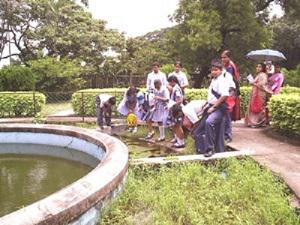
Picture shows local biodiversity field trip at Subhas Sarovar, Kolkata.


Project Report

Herbal Garden Project October 2005

Read Diti's Project Report Below.

File DownloadSize
Project Report58 KB
August 2006 - 2nd RSG Awarded

We believe that there is an urgent need to conserve the biodiversity of India and we can assist in this process by working in our immediate surroundings with youth, who are a very powerful force. Encouraged by the response to our “Programme to Conserve the Biodiversity of Kolkata with school students” funded by Rufford Small Grants Award where we worked in 14 schools in Kolkata for one year, we have undertaken the present programme. We are working with five schools in Kolkata and two schools in the industrial city of Durgapur in West Bengal.

In the schools after an interactive slide-illustrated talk on “Biodiversity of West Bengal” for students of Classes 7 and 8, 25 most interested students are being chosen to form the Core Group with 2 teachers. This team will be taken on a nature walk to an area near the school, involved in nature games and discussions and taken for a biodiversity hotspot visit. After this, the Core Groups in the Durgapur schools will formulate a project to conserve the biodiversity of their area and the Project team will work closely with them for its successful implementation. In the Kolkata schools, the Core Groups will work to sustain their existing projects and scale them up where applicable. The Project team will assist them with expertise and networking support. The previous core group members will be involved in project implementation. After a year, a sharing workshop will be held in Kolkata with the 7 schools, Government Departments, NGOs and concerned individuals/ groups.

The programme is of fourteen months duration. Diti Mookherjee is the Team Leader and is being assisted by the Association for Social and Environmental Development (ASED). Team members are Kushal Mookherjee who is a member of the National Board for Wildlife, India and a member of the State Wildlife Advisory Board, West Bengal, N.N. Chatterjea, an expert on the flora of West Bengal and Pratik Ghosh who is pursuing his doctorate in museology.
The Project is underway. Slide-illustrated talks have been conducted in three schools in Kolkata and these schools are also in the process of formation of the Core Groups.

Project Update June 2007

In the sixth month of our Project, we are progressing well. The school projects are in the process of being continued with the new Core Groups in 4 schools in Kolkata. One school in Kolkata, due to internal administrative issues, started on the programme from June ’07 and should be able to take up their project work in August ‘07. The response from the new schools in Durgapur is very encouraging. The 2 participating schools are Government schools. They will be going on a Biodiversity Hotspot visit in Durgapur in the first week of July ’07, after which they will start working on the school projects.

The participating schools are:

1. Ananda Ashram Balika Vidyapith, Kolkata

2. Beltala Girls’ High School, Kolkata

3. Children’s Foundation, Kolkata

4. Durgapur Taraknath High School, Durgapur

5. Metropolitan Institution (Main), Kolkata

6. Sarengabad Jajneshwari Pathshala Girls’ High School, Kolkata

7. Sagarvanga Government Sponsored High School, Durgapur

Project Update: February 2008

We are nearing the completion of this phase of our project. The ongoing school projects are:
 Sarengabad Jajneswari Girl’s School, Kolkata is conducting a status survey of the Water Monitor Lizard (Varanus salvator) in their local area and preparing a survey report.
 Ananda Ashram Balika Vidyapith is conserving the biodiversity within their school campus, mapping the vegetation in the school neighbourhood and creating public awareness in the locality.
 Beltala Girls’ School has created a medicinal plant garden and has conducted a cultural programme to create awareness in their school about biodiversity conservation.
 Durgapur T.N High School has planted saplings of locally found trees in the school campus.
 Durgapur Sagarvanga Govt. Sponsored High School has planted trees and shrubs in the school campus and listed the insects found there.
 Children’s Foundation and Metropolitan (Main) Institution, due to lack of space, have created a potted plant garden.

A project sharing workshop was held on 30 January 2008 in Kolkata. The participants’ future plans are to:
• Further ongoing school projects.
• Create more public awareness about biodiversity conservation and
• Network with other schools to strengthen the programme, share experiences and learn from each other.

Final Report

Read about the activities undertaken and findings of this project in the final report below.

File DownloadSize
RSG Final Report_07_Diti Mookherjee.doc767.5 KB
RSG Sharing Workshop Report.doc99 KB
RSG Core Group Sensitization Matrix.doc54 KB

Other Projects in: